Face Yoga
15
Feb
2012

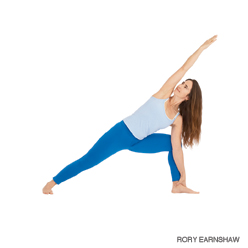
Extended Side Angle Pose
Utthita Parsvakonasana
It might be better, then, to think of Utthita Parsvakonasana as the “Extended Sides Angle Pose.”
(oo-TEE-tah parsh-vah-cone-AHS-anna)
utthita = extended
parsva = side, flank
kona = angle
Step by Step
Stand in Tadasana. On an exhalation, step or lightly jump your feet 3.5 to 4 feet apart. Raise your arms parallel to the floor and reach them actively out to the sides, shoulder blades wide, palms down. Turn your left foot in slightly to the right and your right foot out to the right 90 degrees. Align the right heel with the left heel. Firm your thighs and turn your right thigh outward, so that the center of the kneecap is in line with the center of the right ankle. Roll the left hip slightly forward, toward the right, but rotate your upper torso back to the left.
Anchor the left (back) heel to the floor by lifting the inner left groin deep into the pelvis. Then exhale and bend your right knee over the right ankle, so that the shin is perpendicular to the floor. As you bend the knee aim the inner knee toward the little-toe side of the foot. If possible, bring the right thigh parallel to the floor.
Firm your shoulder blades against the back ribs. Extend your left arm straight up toward the ceiling, then turn the left palm to face toward your head and with an inhalation reach the arm over the back of your left ear, palm facing the floor. Stretch from your left heel through your left fingertips, lengthening the entire left side of your body. Turn your head to look at the left arm. Release your right shoulder away from the ear. Try to create as much length along the right side of your torso as you do along the left.
As you continue to ground your left heel to the floor, exhale and lay the right side of your torso down onto (or bring it as close as possible to) the top of the right thigh. Press your right fingertips (or palm) on the floor just outside of your right foot. Actively push the right knee back against the inner arm; counter this by burrowing your tail bone into the back of your pelvis, toward the pubis. The inside of your right thigh should be parallel with the long edge of your sticky mat.
Stay for 30 seconds to 1 minute. Inhale to come up. Push both heels strongly into the floor and reach the left arm forcefully toward the ceiling to lighten the upward movement. Reverse the feet and repeat for the same length of time to the left. Then come up and return to Tadasana.
“Catch 22 ”
Joseph Heller
Cat Pose
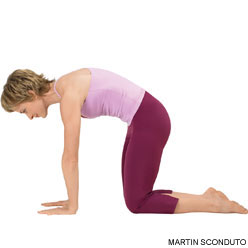
Marjaryasana
Marjari = cat
Step by Step
Start on your hands and knees in a “tabletop” position. Make sure your knees are set directly below your hips and your wrists, elbows and shoulders are in line and perpendicular to the floor. Center your head in a neutral position, eyes looking at the floor.
As you exhale, round your spine toward the ceiling, making sure to keep your shoulders and knees in position. Release your head toward the floor, but don’t force your chin to your chest.
Inhale, coming back to neutral “tabletop” position on your hands and knees.
This pose is often paired with Cow Pose on the inhale for a gentle, flowing vinyasa
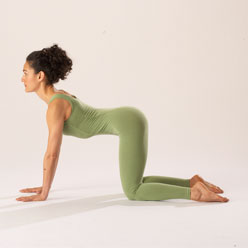
Cow Pose
Bitilasana
Bitilasana_CowPose_248
Step by Step
Start on your hands and knees in a “tabletop” position. Make sure your knees are set directly below your hips and your wrists, elbows and shoulders are in line and perpendicular to the floor. Center your head in a neutral position, eyes looking at the floor.
As you inhale, lift your sitting bones and chest toward the ceiling, allowing your belly to sink toward the floor. Lift your head to look straight forward.
Exhale, coming back to neutral “tabletop” position on your hands and knees. Repeat 10 to 20 times.
This pose is often paired with Cat Pose on the exhale for a gentle, flowing vinyasa.

Come join us for Yoga Wednesdays at 1pm at the Healing Arts Institute in Perrysburg.
My Philosophy
I believe in a heart to heart connection. I believe in intertwining eastern
In today’s on-the-go lifestyle, there is so much pushing to the extreme. The more aches and pains one has, the harder it is to be efficient. Positional Therapy, Yoga and Personal Training build core extremity strength and flexibility as well as releasing muscle tension, thereby balancing effort with ease. Positional Therapy, Massage, Yoga and Personal Training create more space in the body therefore allowing more breath to circulate and enabling blood to flow more easily. The more full one’s breath, the more life is available.
Written By Emily Huber
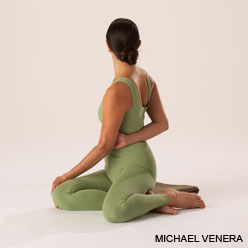
Bharadvajasana I
(bah-ROD-va-JAHS-anna),Bharadvaja = one of seven legendary seers, credited with composing the hymns collected in the Vedas
Step by Step
Sit on the floor with your legs straight out in front of you. Shift over onto your right buttock, bend your knees, and swing your legs to the left. Lay your feet on the floor outside your left hip, with the left ankle resting in the right arch.
Inhale and lift through the top of the sternum to lengthen the front torso. Then exhale and twist your torso to the right, keeping the left buttock on or very close to the floor. Lengthen your tailbone toward the floor to keep the lower back long. Soften the belly.
Tuck your left hand under your right knee and bring your right hand to the floor just beside your right buttock. Pull your left shoulder back slightly, pressing your shoulder blades firmly against your back even as you continue to twist the chest to the right.
You can turn your head in one of two directions: continue the twist of the torso by turning it to the right; or counter the twist of the torso by turning it left and looking over the left shoulder at your feet.
With every inhalation lift a little more through the sternum, using the push of the fingers on the floor to help; with every exhalation twist a little more. Stay for 30 seconds to 1 minute, then release with an exhalation, return to the starting position, and repeat to the left for the same length of time.


Yoga isn’t becoming part of the national elementary school curriculum any time soon. But it is showing up in physical education programs, recess and break-period activities, and even classrooms, integrated into topics including mathematics, art, and science.
Three organizations—YogaKids, of Long Beach, Indiana; Yoga Ed., of Los Angeles; and Yoga’d Up, of London—have launched training programs that educate yoga teachers and school teachers in the U.S. and the U.K. on how to adapt their teaching to appeal to the short attention spans and special needs of young children. These programs also help yoga teachers get established in school systems, get funding for their programs, and, in some cases, go on to become educators who train the teachers who will ultimately integrate yoga into the classroom.
Yoga as a Learning Tool
All three programs use movement as an integrative method for learning. “When you give [kids] yoga poses, use visualization, and allow them to move their bodies, their whole learning ability goes up several notches,” says Marsha Wenig, founder of YogaKids. Yoga Ed.’s Kalish agrees that children learn best by doing. “When you teach kids, it’s not about telling them—it’s about creating experiences for them where they connect the dots, and create new dots.”
“The YogaKids program helps children learn how to control their energy so that they can focus and concentrate better,” adds Amy Haysman, coordinator of the program. “It teaches breathing techniques and poses that help them think more clearly.” For example, bunny breath, short inhalations through the nose and a long exhale through the mouth, can energize kids who need to get focused in order to take a test. Haysman has been hired by schools in Georgia to incorporate yoga into academic classes and physical education programs. In one program, called “Reading Comes Alive with Yoga,” teachers take a book, picture, or story and practice yoga poses associated with animals or objects in the story. “It helps the kids feel like they’re not passively listening. It’s interactive,” Haysman says.