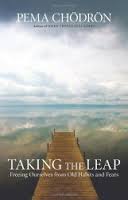
Book for the week
16
Dec
2015




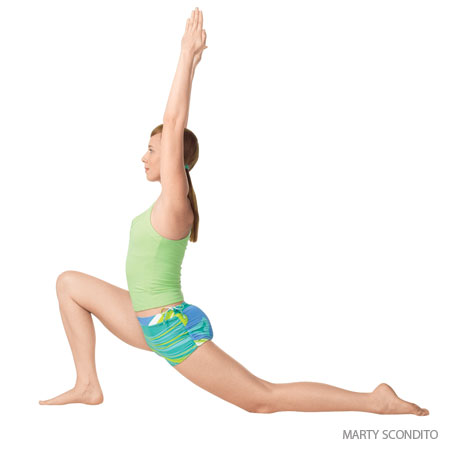
Low Lunge
Low Lunge: Step-by-Step Instructions
From Downward-Facing Dog (Adho Mukha Svanasana), exhale and step your right foot forward between your hands, aligning the right knee over the heel. Then lower your left knee to the floor and, keeping the right knee fixed in place, slide the left back until you feel a comfortable stretch in the left front thigh and groin. Turn the top of your left foot to the floor.
Inhale and lift your torso to upright. As you do, sweep your arms out to the sides and up, perpendicular to the floor. Draw the tailbone down toward the floor and lift your pubic bone toward your navel. Lift your chest from the firmness of your shoulder blades against the back torso.
Take your head back and look up, being careful not to jam the back of your neck. Reach your pinkies toward the ceiling. Hold for a minute, exhale your torso back to the right thigh and your hands to the floor, and turn your back toes under. With another exhale, lift your left knee off the floor and step back to Adho Mukha Svanasana. Repeat with the left foot forward for the same length of time.
YOGA: MEET YOUR EDGE WITH GRACE
Have you ever pushed yourself so hard while exercising that it actually sets you back?
Maybe you had to stop working out for a couple of days or weeks. Maybe you had to go to your Doctor or visit the nearest emergency room.
Is that the point of trying to get fit?
The obvious answer is a resounding- No.
It has been scientifically proven that movement plays an extremely important role in improving and maintaining our body, mind and spirit. Knowing that movement leads to greater plasticity and neuroplasticity, it is wise to view exercise and movement, study and self-discovery as a constant for the rest of our lives. Yet, so many are after the quick fix, the six pack by June, to be able to run a marathon by July and to climb Denali by September. We know it doesn’t work this way. Our life and our bodies require proper training forever.
Forget the saying “No Pain, No Gain.†Can you push yourself and work harder? Absolutely, but intelligently from a physiological perspective, and not from your ego view.
In yoga we say “Meet Your Edge With Grace!
What this means is that everyday our bodies are different and as a result, we need to tune into how we are feeling today and how far can we push ourselves while still obtaining the maximum benefits. Every asana, every pose in yoga, states that it is important to find comfort within your movements. To be able to breath calmly and yet still feel energized and strong. That dose not mean you wont feel invigorated, it means simply taking yourself to your edge and not past it!
Meeting Your Edge With Grace will bring to you a clearing on the other side of your workout, a wonderful feeling of greater health and happiness. Past your edge only brings you injury and pain. People work from either pain or pleasure. When you leave your yoga session, you should feel a glow and euphoria!
When you are in a class and see someone else clearly more flexible than you doesn’t mean that they are getting any more benefits than you. They may be more experienced in the pose; maybe they are naturally more flexible or stronger than you. But, it is important to know that they are not receiving any more benefits than you are. That is the beauty of yoga, of aligning your mind, body and spirit. Yoga done properly is only about how you feel; not how you compare. If you want to see acrobats, go to Cirque Du Soleil.
Yoga is not about being an acrobat or flying from a headstand to handstand all while rubbing your head and belly at the same time! Yoga is about you. About creating daily movement so your body and mind will be forever young at heart and forever young in mind!
Do you want to feel forever young? Of course you do.
It’s easy. Keep Moving!
Namaste’
Michael Zerner


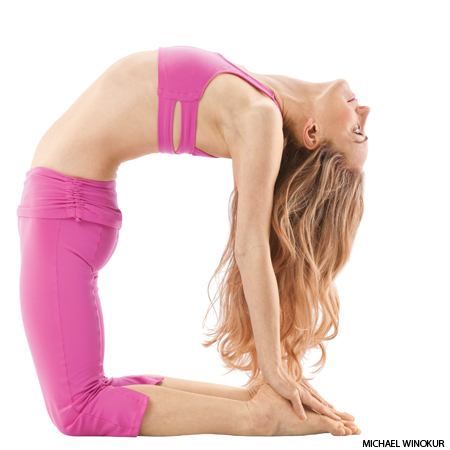
Camel Pose
(oosh-TRAHS-anna)
ustra = camel
Camel Pose: Step-by-Step Instructions
Kneel on the floor with your knees hip width and thighs perpendicular to the floor. Rotate your thighs inward slightly, narrow your hip points, and firm but don’t harden your buttocks. Imagine that you’re drawing your sitting bones up, into your torso. Keep your outer hips as soft as possible. Press your shins and the tops of your feet firmly into floor.
Rest your hands on the back of your pelvis, bases of the palms on the tops of the buttocks, fingers pointing down. Use your hands to spread the back pelvis and lengthen it down through your tail bone. Then lightly firm the tail forward, toward the pubis. Make sure though that your front groins don’t “puff†forward. To prevent this, press your front thighs back, countering the forward action of your tail. Inhale and lift your heart by pressing the shoulder blades against your back ribs.
Now lean back against the firmness of the tail bone and shoulder blades. For the time being keep your head up, chin near the sternum, and your hands on the pelvis. Beginners probably won’t be able to drop straight back into this pose, touching the hands to the feet simultaneously while keeping the thighs perpendicular to the floor. If you need to, tilt the thighs back a little from the perpendicular and minimally twist to one side to get one hand on the same-side foot. Then press your thighs back to perpendicular, turn your torso back to neutral, and touch the second hand to its foot. If you’re not able to touch your feet without compressing your lower back, turn your toes under and elevate your heels.
See that your lower front ribs aren’t protruding sharply toward the ceiling, which hardens the belly and compresses the lower back. Release the front ribs and lift the front of the pelvis up, toward the ribs. Then lift the lower back ribs away from the pelvis to keep the lower spine as long as possible. Press your palms firmly against your soles (or heels), with the bases of the palms on the heels and the fingers pointing toward the toes. Turn your arms outwardly so the elbow creases face forward, without squeezing the shoulder blades together. You can keep your neck in a relatively neutral position, neither flexed nor extended, or drop your head back. But be careful not to strain your neck and harden your throat.
Stay in this pose anywhere from 30 seconds to a minute. To exit, bring your hands onto the front of your pelvis, at the hip points. Inhale and lift the head and torso up by pushing the hip points down, toward the floor. If your head is back, lead with your heart to come up, not by jutting the chin toward the ceiling and leading with your brain. Rest in Child’s Pose for a few breaths.