Pose for the week

Half Frog Pose

Ease up into Half Frog Pose, called Ardha Bhekasana in Sanskrit. This pose strengthens the back while gently opening up the shoulders, chest, and thighs—a loving treat for the entire body.

How to Say Ardha Bhekasana in Sanskrit

Ardha Bhekasana

Half Frog Pose: Step-by-Step Instructions

Photo: Photo: Christopher Dougherty; Mat: Jade Yoga; Props: Hugger Mugger
  1. Begin kneeling with the thighs perpendicular to the floor, and the knees a little narrower than hips distance
  2. Separate the feet slightly wider than the hips, with the tops of the feet flat on the floor
  3. Extend the big toes straight back and firm the outer ankles into the midline
  4. Inhale, lengthen the spine; exhale, lower the hips partway to the heels with the torso leaning slightly forward
  5. Take the thumbs behind the knees and drag the skin and flesh of the calf muscles toward the heels
  6. Lower the sitting bones between the heels and sit upright
  7. Spin the inner thighs towards the floor and descend the roots of the thighs
  8. Make sure the big toes continue to reach straight back and that the outer ankles haven’t bowed out
  9. Align the crown of the head directly above the pelvis
  10. Draw the heads of the upper arms back in line with the side body while softening the front ribs
  11. Rest the hands in the lap or palms down upon the thighs
  12. Hold for 5 breaths to 5 minutes
  13. To exit come on to All-fours and then take Adho Mukha Svanasana to stretch out the backs on the knees 
Pose for the week

Pose for the week

Bridge Pose

Setu Bandha Sarvangasana can be whatever you need—energizing, rejuvenating, or luxuriously restorative.

Bridge Pose (Setu Bandha Sarvangasana) is one of the first back-bending yoga postures that many new students learn. And yet, much like the rest of asana practice, it is also a posture from which you can continue learning for your entire lifetime.

“One of my favorite postures for awakening the senses is Setu Bandha Sarvangasana,” says Yoga Journal contributor Claudia Cummins. “This beginning backbend strengthens the legs and hips, massages the spine, and opens the heart. Methodical practice of this asana also offers an opportunity to explore the body and its movements with attention and care. In the process, the mind is calmed and the body becomes energized, leaving the practitioner feeling revitalized and refreshed.”

This stalwart backbend can be performed restoratively or dynamically—as a resting pose or a strengthener. It will allow you to gain the deep emotional and physical benefits of opening up your chest and thoracic spine.

In Sanskrit, Setu is “bridge,” sarva is “all,” and anga is “limb.” So in Setu Bandha Sarvangasana, the pose you make with your body uses all your limbs to create a bridge. Make a mental picture of a bridge over tranquil water as you breathe deep and muster your energy to lift into this pose.

Bridge Pose Basics

Sanskrit: Setu Bandha Sarvangasana (SEY-tu-BAHN-duh sahr-vahng-GAHS-ah-nuh)

Pose type: Backbend 

Targets: Core 

Why we love it: “Bridge is one pose I can sneak in while getting my kids ready for bed or before or after a workout. In fact, it was one of the first poses I did postpartum—supported, of course, and under the guidance of a physical therapist. On its face, Bridge is not a challenging pose, but when you really tune into your body and breath, even slight adjustments (squeeze those pelvic floor muscles, press those hands into the floor!) make it work for you. As a restorative pose, Bridge is the reset my lower back craves post-walk or hike. But when I want to take it up a notch, I add in some single-leg variations or raise and lower my hips. The next thing I know, I’ve had a little workout—all without standing up!” Erin Skarda, Digital Director

Pose Benefits

Bridge Pose improves posture and counteracts the effects of prolonged sitting and computer work. It may help relieve low back pain and can counteract slouching and kyphosis (abnormal curvature of the spine). The pose gently stretches your abdomen, chest, and the area around your shoulders while strengthening your back muscles, buttocks (glutes), thighs, and ankles.
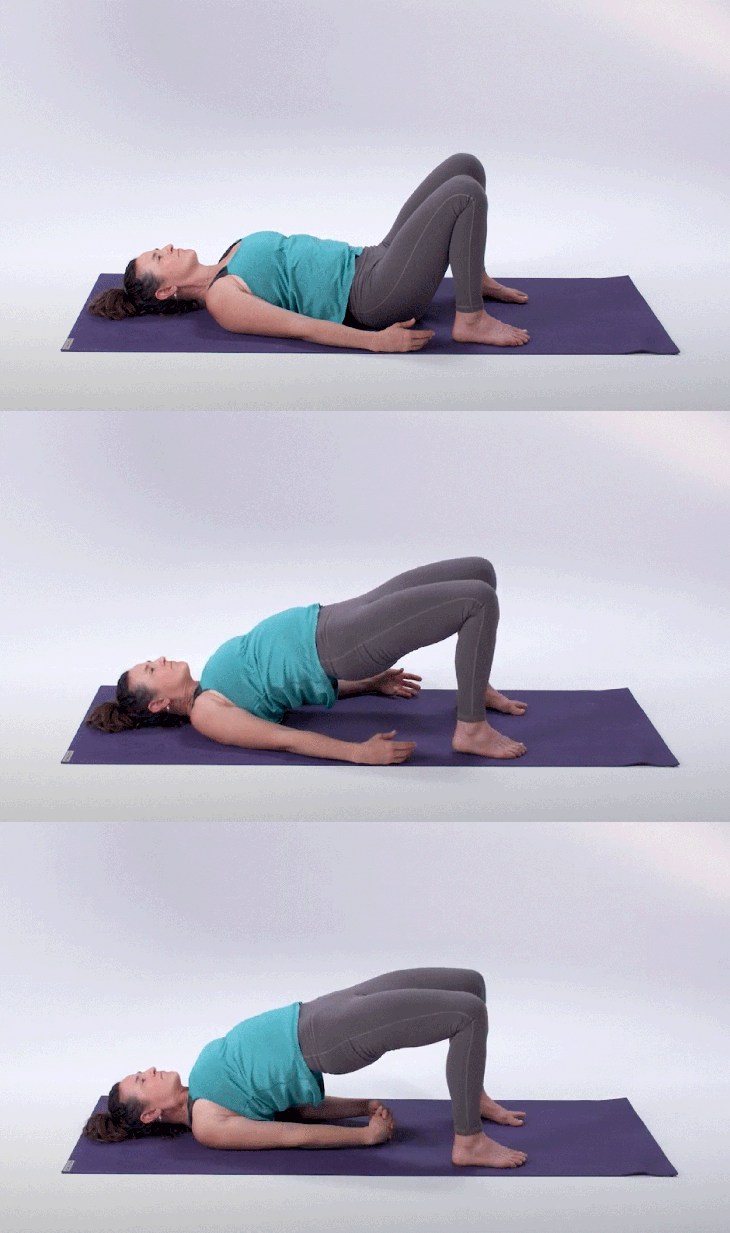
Bridge Pose: Step-by-Step Instructions

Woman demonstrates Bridge Pose
(Photo: Christopher Dougherty)
  1. Lie on your back in the center of your mat with your knees bent, your legs and feet parallel and hip-distance apart.
  2. Move your feet closer to your buttocks. Press down firmly through both of your feet and inhale to raise your hips, lifting from the pubic bone rather than the navel.
  3. Clasp your hands under your back on the floor. Broaden your collarbones and get on top of your shoulders. Firm the outer shins and roll your upper thighs inward. Press down firmly through your heels and lift the back of your thighs and the bottom of your buttocks even higher while keeping the thighs parallel.
  4. To finish, exhale, release your hands, and lower to the floor. Allow your back to rest in a neutral state as you observe the spaciousness within your chest.

Beginner’s tip

To activate your inner thighs and glutes, place a block between your knees and hold it there firmly as you lift and lower your hips.
Teaching Bridge Pose

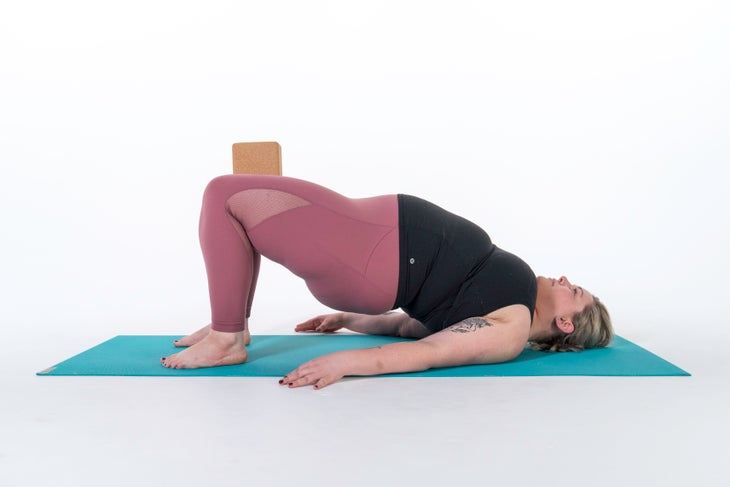
  • If a student needs more support for an achy or weak back, advise them place a block (experiment with the right height) under their sacrum—the flat triangular bone at the base of the spine. They can rest their weight on the block and focus on keeping their knees hip-width apart.
  • For students who wish to make this pose more challenging, invite them to exhale to lift their right knee into their torso, then inhale and extend the leg perpendicular to the floor in this variation of Bridge Pose that helps you keep the hips lifted. Advise them to hold for 30 seconds, then release their foot to the floor again with an exhalation. Then they can secure the right foot and repeat with their left leg for the same length of time.

Variation: Bridge Pose with a block

Try with a block between your thighs to focus on inner thigh strength.


Pose for the week



