Pose for the week

Wide-Angle Seated Forward Bend
Upavistha Konasana

(oo-pah-VEESH-tah cone-AHS-anna)
upavistha = seated, sitting
kona = angle

Step by Step

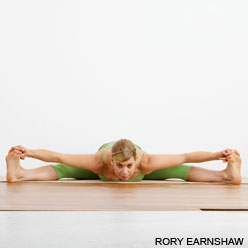
Sit in Dandasana, then lean your torso back slightly on your hands and lift and open your legs to an angle of about 90 degrees (the legs should form an approximate right angle, with the pubis at the apex). Press your hands against the floor and slide your buttocks forward, widening the legs another 10 to 20 degrees. As with Dandasana, if you can’t sit comfortably on the floor, raise your buttocks on a folded blanket.

Rotate your thighs outwardly, pinning the outer thighs against the floor, so that the knee caps point straight up toward the ceiling. Reach out through your heels and stretch your soles, pressing though the balls of the feet.

With your thigh bones pressed heavily into the floor and your knee caps pointing up at the ceiling, walk your hands forward between your legs. Keep your arms long. As with all forward bends, the emphasis is on moving from the hip joints and maintaining the length of the front torso. As soon as you find yourself bending from the waist, stop, re-establish the length from the pubis to the navel, and continue forward if possible.

Increase the forward bend on each exhalation until you feel a comfortable stretch in the backs of your legs. Stay in the pose 1 minute or longer. Then come up on an inhalation with a long front torso.
No Comments Pose for the week

Pose for the week

Gate Pose
Parighasana
(par-ee-GOSS-anna)
parigha = an iron bar or beam used for locking or shutting a gate

The pose described immediately below is a simplified variation of the full pose. Then we describe the full pose afterward.

Step by Step

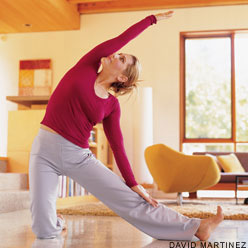
Kneel on the floor. Stretch your right leg out to the right and press the foot to the floor. Keep your left knee directly below your left hip (so the thigh is perpendicular to the floor), and align your right heel with the left knee. Turn your pelvis slightly to the right (so the left hip point comes forward of the right), but turn your upper torso back to the left. Point the kneecap toward the ceiling, which will require you to turn your right leg out.

As you inhale, bring your arms out to your sides, parallel to the floor, palms down. Bend to the right over the plane of the right leg and lay your right hand down on the shin, ankle, or the floor outside the right leg. Contract the right side of the torso and stretch the left. Place your left hand on the outer left hip and push the pelvis down toward the floor. Then slip the hand up to the lower left ribs and lift them toward the shoulder, creating space in the left waist.

With an inhalation, sweep the left arm over the back of the left ear. The side bend tends to drop the torso toward the floor. Without pushing the left hip back (continue to roll it slightly forward), turn the upper torso away from the floor.

Stay in this pose anywhere from 30 seconds to a minute. Come up as you inhale, reaching through the top arm to draw the torso upright. Bring the right knee back beside the left, and repeat with the legs reversed.

Full Pose
Full Parighasana is a deep side bend. From the starting position described in Step 2 above, lean to the side over the straight leg. Lower the underside of the torso as close as possible to the top of the straight leg. Press the back of the lower hand on the top of the foot, then sweep the top arm over the back of the ear and join the palms. Finish as described in Step 4 above.

No Comments Pose for the week

Yoga pose for the week

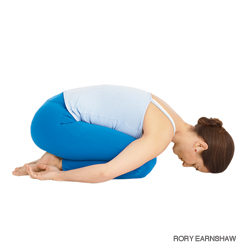
Child’s Pose
Balasana

(bah-LAHS-anna)
bala = child

Step by Step

Kneel on the floor. Touch your big toes together and sit on your heels, then separate your knees about as wide as your hips.

Exhale and lay your torso down between your thighs. Broaden your sacrum across the back of your pelvis and narrow your hip points toward the navel, so that they nestle down onto the inner thighs. Lengthen your tailbone away from the back of the pelvis while you lift the base of your skull away from the back of your neck.

Lay your hands on the floor alongside your torso, palms up, and release the fronts of your shoulders toward the floor. Feel how the weight of the front shoulders pulls the shoulder blades wide across your back.

Balasana is a resting pose. Stay anywhere from 30 seconds to a few minutes. Beginners can also use Balasana to get a taste of a deep forward bend, where the torso rests on the thighs. Stay in the pose from 1 to 3 minutes. To come up, first lengthen the front torso, and then with an inhalation lift from the tailbone as it presses down and into the pelvis.

No Comments Pose for the week

Pose for the week

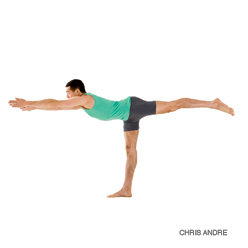
Warrior III Pose
Virabhadrasana III

(veer-ah-bah-DRAHS-anna)

Virabhadra = the name of a fierce warrior, an incarnation of Shiva, described as having a thousand heads, a thousand eyes, and a thousand feet; wielding a thousand clubs; and wearing a tiger’s skin.

Step by Step

Stand in Tadasana, exhale and fold foward to Uttanasana. From Uttanasana, exhale and step your left foot back into a high lunge position. Your right knee should be more or less at a right angle. Lay the midline of your torso (from the pubis to the sternum) down on the midline of the right thigh (from the knee to the hip crease) and bring your hands to your right knee, right hand to the outer knee, left hand to the inner. Squeeze the knee with your hands, lift your torso slightly, and with an exhalation, turn it slightly to the right.

Now from the lunge position, stretch your arms forward, parallel to the floor and parallel to each other, palms facing each other. Exhale and press the head of the right thighbone back and press the heel actively into the floor. Synchronize the straightening of the front leg and the lifting of the back leg. As you lift the back leg, resist by pressing the tailbone into the pelvis.

Normally students come up into Virabhadrasana III by lunging the torso forward. This tends to shift the body weight onto the ball of the front foot and unbalance the position. Don’t allow the torso to swing forward as you move into position; instead, as you straighten the front knee, think of pressing the head of the thighbone back. This centers the femur in the hip joint, grounds the heel into the floor, and stabilizes the position.

The arms, torso, and raised leg should be positioned relatively parallel to the floor. For many students the pelvis tends to tilt. Release the hip [of the raised leg] toward the floor until the two hip points are even and parallel to the floor. Energize the back leg and extend it strongly toward the wall behind you; reach just as actively in the opposite direction with the arms. Bring the head up slightly and look forward, but be sure not to compress the back of your neck.

Stay in this position for 30 seconds to a minute. Release back to the lunge on an exhalation. Bring your hands to the floor on either side of the right foot, and on an exhalation, step your left foot forward to meet your right. Stay in this forward bend for a few breaths, then repeat for the same length of time on the other side.

No Comments Pose for the week

Yoga Pose

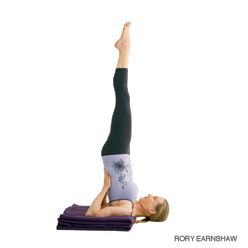
Supported Shoulderstand
Salamba Sarvangasana

(sah-LOM-bah sar-van-GAHS-anna)
salamba = with support (sa = with
alamba = support)
sarva = all
anga = limb. There are variations of Shoulderstand that are “unsupported” = niralamba, pronounced near-ah-LOM-bah)

Step by Step

Fold two or more firm blankets into rectangles measuring about 1 foot by 2 feet, and stack them one on top of the other. You can place a sticky mat over the blankets to help the upper arms stay in place while in the pose. Then lie on the blankets with your shoulders supported (and parallel to one of the longer edges) and your head on the floor. Lay your arms on the floor alongside your torso, then bend your knees and set your feet against the floor with the heels close to the sitting bones. Exhale, press your arms against the floor, and push your feet away from the floor, drawing your thighs into the front torso.

Continue to lift by curling the pelvis and then the back torso away from the floor, so that your knees come toward your face. Stretch your arms out parallel to the edge of the blanket and turn them outward so the fingers press against the floor (and the thumbs point behind you). Bend your elbows and draw them toward each other. Lay the backs of your upper arms on the blanket and spread your palms against the back of your torso. Raise your pelvis over the shoulders, so that the torso is relatively perpendicular to the floor. Walk your hands up your back (toward the floor) without letting the elbows slide too much wider than shoulder width.

Inhale and lift your bent knees toward the ceiling, bringing your thighs in line with your torso and hanging the heels down by your buttocks. Press your tailbone toward your pubis and turn the upper thighs inward slightly. Finally inhale and straighten the knees, pressing the heels up toward the ceiling. When the backs of the legs are fully lengthened, lift through the balls of the big toes so the inner legs are slightly longer than the outer.

Soften the throat and tongue. Firm the shoulder blades against the back, and move the sternum toward the chin. Your forehead should be relatively parallel to the floor, your chin perpendicular. Press the backs of your upper arms and the tops of your shoulders actively into the blanket support, and try to lift the upper spine away from the floor. Gaze softly at your chest.

As a beginning practitioner stay in the pose for about 30 seconds. Gradually add 5 to 10 seconds to your stay every day or so until you can comfortably hold the pose for 3 minutes. Then continue for 3 minutes each day for a week or two, until you feel relatively comfortable in the pose. Again gradually and 5 to 10 seconds onto your stay every day or so until you can comfortably hold the pose for 5 minutes. To come down, exhale, bend your knees into your torso again, and roll your back torso slowly and carefully onto the floor, keeping the back of your head on the floor.

No Comments Pose for the week

Yoga Pose

Eagle Pose
Garudasana

(gah-rue-DAHS-anna)
Garuda = the mythic “king of the birds,” the vehicle of Vishnu. The word is usually rendered into English as “eagle,” though according to one dictionary the name literally means “devourer,” because Garuda was originally identified with the “all-consuming fire of the sun’s rays.”

Step by Step

Stand in Tadasana. Bend your knees slightly, lift your left foot up and, balancing on your right foot, cross your left thigh over the right. Point your left toes toward the floor, press the foot back, and then hook the top of the foot behind the lower right calf. Balance on the right foot.

Stretch your arms straight forward, parallel to the floor, and spread your scapulas wide across the back of your torso. Cross the arms in front of your torso so that the right arm is above the left, then bend your elbows. Snug the right elbow into the crook of the left, and raise the forearms perpendicular to the floor. The backs of your hands should be facing each other.

Press the right hand to the right and the left hand to the left, so that the palms are now facing each other. The thumb of the right hand should pass in front of the little finger of the left. Now press the palms together (as much as is possible for you), lift your elbows up, and stretch the fingers toward the ceiling.

Stay for 15 to 30 seconds, then unwind the legs and arms and stand in Tadasana again. Repeat for the same length of time with the arms and legs reversed.

No Comments Pose for the week

Yoga Poses

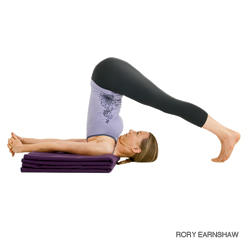
Plow Pose
Halasana

(hah-LAHS-anna)
hala = plow

Step by Step

From Salamba Sarvangasana, exhale and bend from the hip joints to slowly lower your toes to the floor above and beyond your head. As much as possible, keep your torso perpendicular to the floor and your legs fully extended.

With your toes on the floor, lift your top thighs and tailbone toward the ceiling and draw your inner groins deep into the pelvis. Imagine that your torso is hanging from the height of your groins. Continue to draw your chin away from your sternum and soften your throat.

You can continue to press your hands against the back torso, pushing the back up toward the ceiling as you press the backs of the upper arms down, onto your support. Or you can release your hands away from your back and stretch the arms out behind you on the floor, opposite the legs. Clasp the hands and press the arms actively down on the support as you lift the thighs toward the ceiling.

Halasana is usually performed after Sarvangasana for anywhere from 1 to 5 minutes. To exit the pose bring your hands onto your back again, lift back into Sarvangasana with an exhalation, then roll down onto your back, or simply roll out of the pose on an exhalation.

No Comments Pose for the week

Yoga Pose

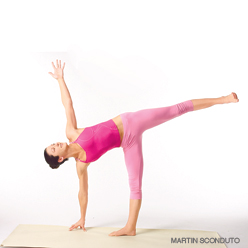
Half Moon Pose
Ardha Chandrasana

The moon has a rich symbolic significance in yoga mythology. In hatha yoga, for example, the sun and the moon represent the two polar energies of the human body. In fact, the word hatha itself is often divided into its two constituent syllables, “ha” and “tha”, which are then esoterically interpreted as signifying the solar and lunar energies respectively.

(are-dah chan-DRAHS-anna)
ardha = half
candra = glittering, shining, having the brilliancy or hue of light (said of the gods); usually translated as “moon”

Step by Step

Perform Utthita Trikonasana to the right side, with your left hand resting on the left hip. Inhale, bend your right knee, and slide your left foot about 6 to 12 inches forward along the floor. At the same time, reach your right hand forward, beyond the little-toe side of the right foot, at least 12 inches.

Exhale, press your right hand and right heel firmly into the floor, and straighten your right leg, simultaneously lifting the left leg parallel (or a little above parallel) to the floor. Extend actively through the left heel to keep the raised leg strong. Be careful not to lock (and so hyperextend) the standing knee: make sure the kneecap is aligned straight forward and isn’t turned inward.

Rotate your upper torso to the left, but keep the left hip moving slightly forward. Most beginners should keep the left hand on the left hip and the head in a neutral position, gazing forward.

Bear the body’s weight mostly on the standing leg. Press the lower hand lightly to the floor, using it to intelligently regulate your balance. Lift the inner ankle of the standing foot strongly upward, as if drawing energy from the floor into the standing groin. Press the sacrum and scapulas firmly against the back torso, and lengthen the coccyx toward the raised heel.

Stay in this position for 30 seconds to 1 minute. Then lower the raised leg to the floor with an exhalation, and return to Trikonasana. Then perform the pose to the left for the same length of time.

No Comments Pose for the week

Yoga Poses

Upward Abdominal Lock
Uddiyana Bandha

(oo-dee-YAH-nah BAHN-dah
uddiyana = upward (cf. ud = “up, upwards”)
bandha = binding, tying a bond, fetter; putting together, uniting, contracting, combining; mundane bondage, attachment to this world (as opposed to emancipation, mukti or moksha).

There are a few important points to remember when beginning the practice of Uddiyana Bandha: perform it only on an empty stomach, and only after an exhalation, never before an inhalation. During the time you hold the bandha, also perform Jalandhara Bandha. Most teachers recommend that you learn this bandha in a standing position, and only move to sitting after you’ve gained some experience. Similarly, wait until you’ve been sitting for a while before using this bandha during pranayama. T.K.V. Desikachar suggests that Uddiyana can also be learned in a supine reclining position (see the Variation section below).

Step by Step

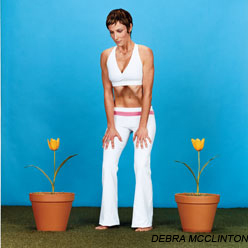
Stand with your feet slightly apart, eyes open. Different teachers have different ideas about the proper way to perform this bandha. Here are four possibilities:
a) Practice with your torso rounded forward, knees bent, hands resting on your knees.
b) Learn the bandha first with your torso rounded forward and then, after getting some experience, practice the bandha standing upright, hands on hips.
c) Practice throughout with your torso upright.
d) Start the practice with your torso rounded forward, perform Uddiyana Bandha, and then stand upright, with your hands on your hips (Iyengar).

Inhale deeply through your nose, then exhale quickly and forcibly, also through your nose (or pursed lips). Contract your abdominal muscles fully to push as much air as possible out of your lungs. Then relax your abdominals.

Perform what’s called a “mock inhalation”; that is, expand your rib cage (thorax) as if you were inhaling, but don’t actually inhale. The expansion of the rib cage (without the inhalation) sucks the abdominal muscles and viscera up into the thorax and hollows the belly (some teachers say to actively but slowly lift abdominals, or navel, toward the spine). Because you should always perform Jalandhara Bandha along with Uddiyana Bandha, come into Jalandhara Bandha at this point.

Hold the bandhas for five to 15 seconds. Then slowly release the abdominal grip and inhale normally. Perform three to 10 rounds, depending on your capacity, with one or more normal breaths between each round.

No Comments Pose for the week

Yoga Poses

Lion Pose
Simhasana

(sim-HAHS-anna)
simha = lion

Step by Step

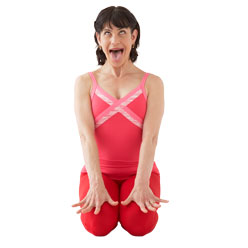
Kneel on the floor and cross the front of the right ankle over the back of the left. The feet will point out to the sides. Sit back so the perineum snuggles down onto the on the top (right) heel.

Press your palms firmly against your knees. Fan the palms and splay your fingers like the sharpened claws of a large feline.

Take a deep inhalation through the nose. Then simultaneously open your mouth wide and stretch your tongue out, curling its tip down toward the chin, open your eyes wide, contract the muscles on the front of your throat, and exhale the breath slowly out through your mouth with a distinct “ha” sound. The breath should pass over the back of the throat.

Some texts instruct us to set our gaze (drishti) at the spot between the eyebrows. This is called “mid-brow gazing” (bhru-madhya-drishti; bhru = the brow; madhya = middle).Other texts direct the eyes to the tip of the nose (nasa-agra-drishti; nasa = nose; agra = foremost point or part, i.e., tip).

You can roar two or three times. Then change the cross of the legs and repeat for the same number of times.

No Comments Pose for the week