Thoughts
30
Dec
2015





Peak Form: 5 Steps to Ardha Chandra Chapasana
By carefully carving a pathway to Ardha Chandra Chapasana, you’ll reach new heights in your body and mind.
If Ardha Chandra Chapasana is the peak you’re eyeing, says Power Yoga teacher Baron Baptiste, each step on the path must be mastered before you can get to the top. A powerful heart opener, this challenging variation of Half Moon Pose offers both a balancing posture and an asymmetrical backbend. Baptiste, founder of the Baptiste Power Yoga Institute, says it’s the taste of freedom he experiences when practicing precision with a sincere willingness to be open to new physical possibilities that keeps him coming back to Ardha Chandra Chapasana year after year.
But ascending to the peak of any pose requires a steady foundation. The key to feeling the freedom Baptiste is speaking of, in your day-to-day practice as well as in the peak pose, lies in giving detailed attention to the integrity of your alignment in every moment of every pose. What at first might seem confining or even tedious—this detailed attention to the placement of a hand or the toes—is what will ultimately provide the integrity for the body, and therefore the spirit, to soar in the final backbend. “Precision gives access to integration in a way that keeps you safe and supported,†says Baptiste. “When you work with precision, you create the space to explore what’s possible in your body, which keeps your practice energized instead of static.â€
Baptiste recommends approaching this sequence like a climber ascending a peak with multiple pitches: At each natural pause in the ascent, ask yourself, “Am I on firm enough ground to continue? Do I feel secure? Do I feel supported?†Then, as you move through each pose in the sequence, stop to regroup, check your “safety gear,†and reestablish your composure. Take the time to check and recheck the places in your body and psyche that might be vulnerable to injury or weakness. Make an extra effort to keep those areas open and supported, firm yet free.
Keep in mind that precision is different from perfectionism. By Baptiste’s definition, working precisely requires mindfulness of action. When you move mindfully on your mat and when you use precision to create stability in your poses, you begin to carve the pathway that takes you to new heights in your practice. And when you witness the benefits of working with precision on your mat, Baptiste believes that you will feel empowered to make positive changes in your life, too. “The power to change your body through yoga creates confidence in your ability to change your life in ways you didn’t think possible,†says Baptiste. “With a mindful, conscious practice, you can connect with your personal power, your ability to change your life.â€
Perfectionism, on the other hand, is rife with self-criticism and judgment. Begin to cast judgment on your pose, your practice, or yourself as “right†or “wrong,†and the ledge you’re on can expand into a never-ending plateau of self-doubt. When you aspire to create “perfect†poses, you miss out on witnessing the fullness of each moment—whether positive or negative. Precision is about process. Perfectionism occurs when you believe the myth that there is an endpoint in your yoga practice.
In this adventurous sequence leading to Ardha Chandra Chapasana, you’ll explore a liberating approach to balance, backbending, and hip opening. Take action with precision—moving body and mind with care and confidence—and you’ll find there’s more space to explore the possibilities of this pose than you imagined.


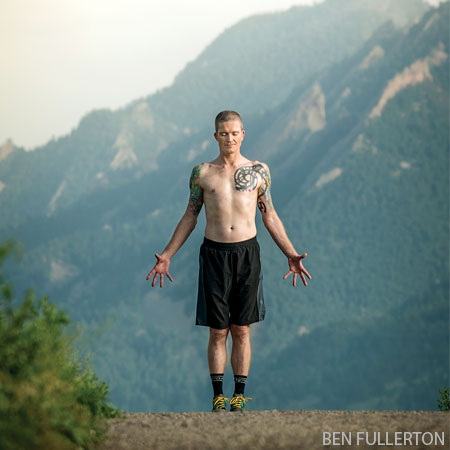
Mountain Pose
(tah-DAHS-anna)
tada = mountain
Mountain Pose: Step-by-Step Instructions
Stand with the bases of your big toes touching, heels slightly apart (so that your second toes are parallel). Lift and spread your toes and the balls of your feet, then lay them softly down on the floor. Rock back and forth and side to side. Gradually reduce this swaying to a standstill, with your weight balanced evenly on the feet.
Firm your thigh muscles and lift the knee caps, without hardening your lower belly. Lift the inner ankles to strengthen the inner arches, then imagine a line of energy all the way up along your inner thighs to your groins, and from there through the core of your torso, neck, and head, and out through the crown of your head. Turn the upper thighs slightly inward. Lengthen your tailbone toward the floor and lift the pubis toward the navel.
Press your shoulder blades into your back, then widen them across and release them down your back. Without pushing your lower front ribs forward, lift the top of your sternum straight toward the ceiling. Widen your collarbones. Hang your arms beside the torso.
Balance the crown of your head directly over the center of your pelvis, with the underside of your chin parallel to the floor, throat soft, and the tongue wide and flat on the floor of your mouth. Soften your eyes.
Tadasana is usually the starting position for all the standing poses. But it’s useful to practice Tadasana as a pose in itself. Stay in the pose for 30 seconds to 1 minute, breathing easily.