Book for the week
07
Jun
2021




Sep 1
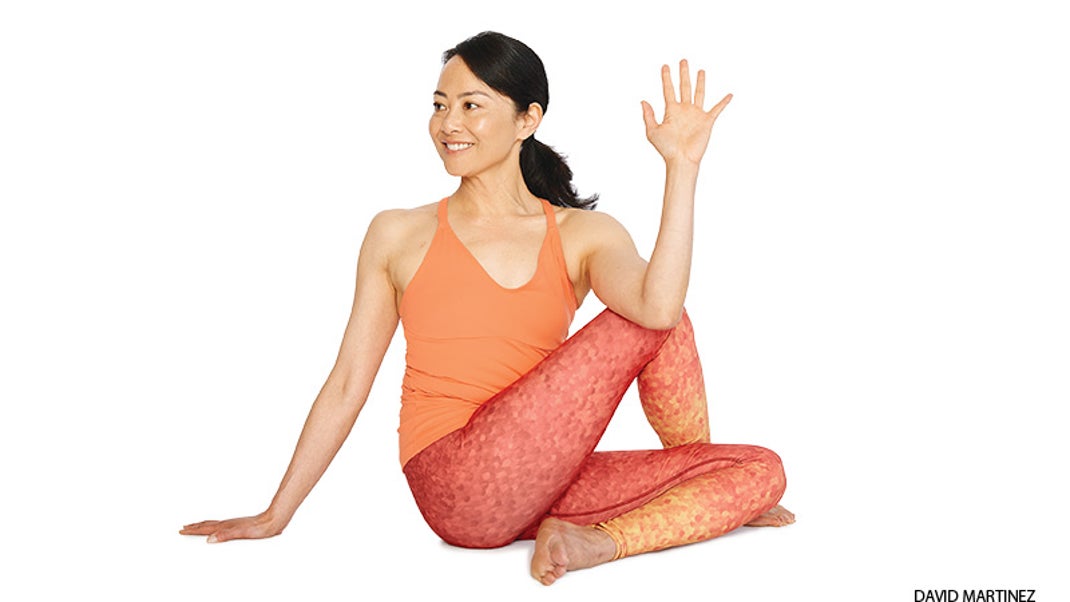
Sit on the floor with your legs straight out in front of you, buttocks supported on a folded blanket. Bend your knees, put your feet on the floor, then slide your left foot under your right leg to the outside of your right hip. Lay the outside of the left leg on the floor. Step the right foot over the left leg and stand it on the floor outside your left hip. The right knee will point directly up at the ceiling.
Step 2
Exhale and twist toward the inside of the right thigh. Press the right hand against the floor just behind your right buttock, and set your left upper arm on the outside of your right thigh near the knee. Pull your front torso and inner right thigh snugly together.
Step 3
Press the inner right foot very actively into the floor, release the right groin, and lengthen the front torso. Lean the upper torso back slightly, against the shoulder blades, and continue to lengthen the tailbone into the floor.
Step 4
You can turn your head in one of two directions: Continue the twist of the torso by turning it to the right; or counter the twist of the torso by turning it left and looking over the left shoulder at the right foot.
Step 5
With every inhalation lift a little more through the sternum, pushing the fingers against the floor to help. Twist a little more with every exhalation. Be sure to distribute the twist evenly throughout the entire length of the spine; don’t concentrate it in the lower back. Stay for 30 seconds to 1 minute, then release with an exhalation, return to the starting position, and repeat to the left for the same length of time. Watch a video demonstration of this pose.
Ardha Matsyendrasana
1


KEEP YOUR LEGS🦵🏽 STRONG – A MUST READ ARTICLE
Â
▪When we are old, our feet must always remain strong.
▪When we age, we should not be afraid of hair turning grey (or)Â skin sagging (or) wrinkles.
▪Among the signs of *longevity,* as summarized by the US Magazine “Prevention”, *strong leg muscles* are listed on the top, as *the most important and essential one.*
▪Do not move your legs for two weeks & your leg strength will decrease by 10 years.
▪A study from the University of Copenhagen in Denmark found that both old and young, during the two weeks of *inactivity,* _the legs muscle strength got weakened by a third_ which is *equivalent to 20-30 years of ageing.*
▪As our leg muscles weaken, it will take a long time to recover, even if we do rehabilitation exercises, later.
▪Therefore, regular exercise like walking, is very important.
▪The whole body weight/load remain on legs.
▪The feet are a kind of *pillars,* bearing the weight of the human body.
▪Interestingly, 50% of a person’s bones and 50% of the muscles, are in the two legs.
▪The largest and strongest joints and bones of the human body are also in the legs.
▪Strong bones, strong muscles, and flexible joints form the “Iron Triangle” that carries the most important load on the human body.
▪70% of human activity and burning of energy in one’s life, is done by the two feet.
▪Do you know this? When a person is young, his *thighs have enough strengths, to lift a small car!
▪The foot is the *center of body locomotion.
▪Both the legs together have 50% of the nerves of the human body, 50% of the blood vessels and 50% of the blood flowing through them.
▪It is the large circulatory network that connects the body.
▪Only when the feet are healthy then the *convention current of blood* *flows, smoothly, so people who have strong leg muscles will definitely have a *strong heart.*
▪Aging starts from the feet upwards.
▪As a person gets older, the accuracy and speed of transmission of instructions between the brain and the legs decreases, unlike when a person is young.
▪In addition, the so-called *Bone Fertilizer Calcium* will sooner or later be lost with the passage of time, making the elderly more prone to bone fractures.
▪Fractures in the elderly easily triggers a series of complications, especially fatal diseases such as brain thrombosis.
▪Do you know that 15% of elderly patients will die within a year of a thigh-bone fracture.
▪Exercising the legs, is never too late, even after the age of 60 years.
▪Although our feet will gradually age with time, exercising our feet is a life-long task.
▪Only by strengthening the legs, one can prevent further aging.
▪Please walk for at least 30-40 minutes, daily to ensure that your legs receive sufficient exercise and to ensure that your leg muscles remain healthy.

(bahk-AHS-anna)
baka = crane
Step 1
Squat down from Tadasana with your inner feet a few inches apart. If it isn’t possible to keep your heels on the floor, support them on a thickly folded blanket. Separate your knees wider than your hips and lean the torso forward, between the inner thighs. Stretch your arms forward, then bend your elbows, place your hands on the floor and the backs of the upper arms against the shins.
Step 2
Snuggle your inner thighs against the sides of your torso, and your shins into your armpits, and slide the upper arms down as low onto the shins as possible. Lift up onto the balls of your feet and lean forward even more, taking the weight of your torso onto the backs of the upper arms. In Bakasana you consciously attempt to contract your front torso and round your back completely. To help yourself do this, keep your tailbone as close to your heels as possible.
Step 3
With an exhalation, lean forward even more onto the backs of your upper arms, to the point where the balls of your feet leave the floor. Now your torso and legs are balanced on the backs of your upper arms. As a beginner at this pose, you might want to stop here, perched securely on the bent arms.
Step 4
But if you are ready to go further, squeeze the legs against the arms, press the inner hands firmly to the floor and (with an inhalation) straighten the elbows. Seen from the side the arms are angled slightly forward relative to the floor. The inner knees should be glued to the outer arms, high up near the armpits. Keep the head in a neutral position with your eyes looking at the floor, or lift the head slightly, without compressing the back of the neck, and look forward.
Step 5
Stay in the pose anywhere from 20 seconds to 1 minute. To release, exhale and slowly lower your feet to the floor, back into a squat.
Bakasana
