
Poem for the week
05
Jul
2021





We’ll start with a modified version of the pose. The full pose will be described in the Variation section below.
(not-ah-raj-AHS-anna)
nata = actor, dancer, mime
raja = king
Step 1
Stand in Tadasana (Mountain Pose). Inhale, shift your weight onto your right foot, and lift your left heel toward your left buttock as you bend the knee. Press the head of your right thigh bone back, deep into the hip joint, and pull the knee cap up to keep the standing leg straight and strong.
Step 2
There are two variations you might try here with your arms and hands. In either case, try to keep your torso relatively upright. The first is to reach back with your left hand and grasp the outside of your left foot or ankle. To avoid compression in your lower back, actively lift your pubis toward your navel, and at the same time, press your tailbone toward the floor.
Step 3
Begin to lift your left foot up, away from the floor, and back, away from your torso. Extend the left thigh behind you and parallel to the floor. Stretch your right arm forward, in front of your torso, parallel to the floor.
Step 4
The second option with the hands is to sweep your right hand around behind your back and catch hold of the inner left foot. Then sweep the left hand back and grab the outside of the left foot. This variation will challenge your balance even more. Then raise the thigh as described in step 3. This second variation will increase the lift of your chest and the stretch of your shoulders.
Step 5
Stay in the pose for 20 to 30 seconds. Then release the grasp on the foot, place the left foot back onto the floor, and repeat for the same length of time on the other side.
For the full pose, perform step 1 as described above. Then turn your left arm actively outward (so the palm faces away from the side of the torso), bend the elbow, and grip the outside of the left foot. (You can also grab the big toe with the first two fingers and the thumb.) The fingers will cross the top of the foot, the thumb will press against the sole. Inhale, lift the left leg up, and bring the thigh parallel to the floor. As you do this, rotate the left shoulder in such a way that the bent elbow swings around and up, so that it points toward the ceiling. It requires extreme flexibility to externally rotate and flex the shoulder joint in this way. Reach the right arm straight forward, in front of the torso and parallel to the floor. Hold for 20 to 30 seconds, release, and repeat on the second side for the same length of time.
Natarajasana
1
Balance can be difficult in the modified version. Try bracing the free hand against a wall to help you stay stable.
You can move even further into this pose by grasping the raised foot with the off-side hand. Complete the pose as described above in the Full Pose section. Then inhale and swing the free hand first up toward the ceiling, then bend the elbow and reach for the inside of the raised foot.
Natarajasana is usually performed as the final pose of a series of challenging backbends. You’ll probably want to release the spine by coming to Ardha Uttanasana (Half Uttanasana), also known as Right Angle Pose, at the wall or reclining twist.
Many beginners, when lifting the leg, tend to cramp in the back of the thigh. Be sure to keep the ankle of the raised foot flexed; that is, draw the top of the foot toward the shin.



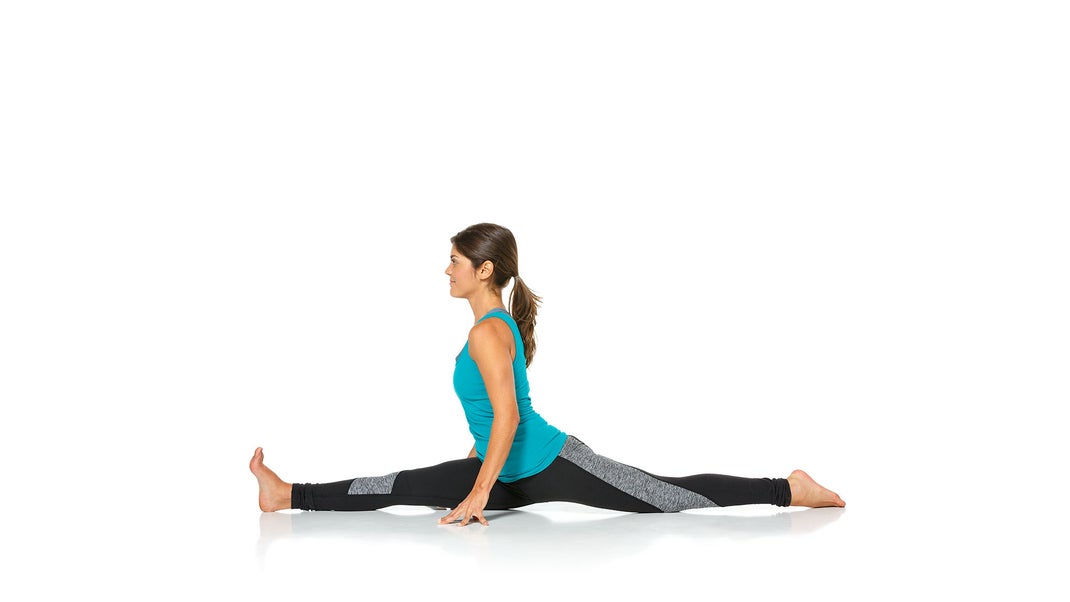
(hah-new-mahn-AHS-anna)
“It was the greatest leap ever taken. The speed of Hanuman’s jump pulled blossoms and flowers into the air after him and they fell like little stars on the waving treetops. The animals on the beach had never seen such a thing; they cheered Hanuman, then the air burned from his passage, and red clouds flamed over the sky . . .†(Ramayana, retold by William Buck).
This pose then, in which the legs are split forward and back, mimics Hanuman’s famous leap from the southern tip of India to the island of Sri Lanka.
Practice this pose on a bare floor (without a sticky mat) with folded blankets under the back knee and front heel.
Step 1
Kneel on the floor. Step your right foot forward about a foot in front of your left knee, and rotate your right thigh outwardly. Do this by lifting the inner sole away from the floor and resting the foot on the outer heel.
Step 2
Exhale and lean your torso forward, pressing your fingertips to the floor. Slowly slide your left knee back, straightening the knee and at the same time descending the right thigh toward the floor. Stop straightening the back knee just before you reach the limit of your stretch.
Step 3
Now begin to push the right heel away from your torso. Because we started with a strong external rotation of the front leg, gradually turn the leg inward as it straightens to bring the kneecap toward the ceiling. As the front leg straightens, resume pressing the left knee back, and carefully descend the front of the left thigh and the back of the right leg (and the base of the pelvis) to the floor. Make sure the center of the right knee points directly up toward the ceiling.
Step 4
Also check to see that the back leg extends straight out of the hip (and isn’t angled out to the side), and that the center of the back kneecap is pressing directly on the floor. Keep the front leg active by extending through the heel and lifting the ball of the foot toward the ceiling. Bring the hands into Anjali Mudra (Salutation Seal) or stretch the arms straight up toward the ceiling.
Step 5
Stay in this pose for 30 seconds to a minute. To come out, press your hands to the floor, turn the front leg out slightly, and slowly return the front heel and the back knee to their starting positions. Then reverse the legs and repeat for the same length of time.


