untitled

Shoulder Stand

Shoulder Stand is fun,
I find myself looking up to the sky, the stars, the moon, the sun.
The Queen of all poses, it’s great to do, it’s fantastic for your body too!
You’ll love it, yes you will.
Salamba Sarvangasana is the Sanskrit name,
Looking upside down is your view, your aim.
Seldom do we reverse our fluid flow, with Shoulder Stand you will and as a result, feel that wonderful glow!

Mike Z

Tips

Asana for the week

201504-yjmag-camel-kino

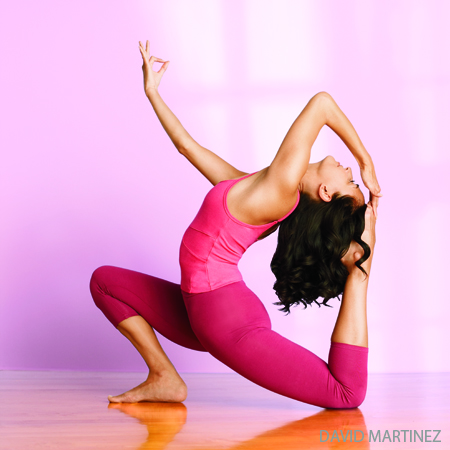
7 Steps to Master Camel Pose (Ustrasana)
Yoga Journal

Benefit
Strengthens the back; opens the shoulders, chest, and quadriceps; boosts mood and energy.
Instruction
1 Come to your knees, with your legs hip-width apart. Place your hands on your hips, with your thumbs on your sacrum, the bony plate at the base of your spine. Keep your hips over your knees and internally rotate your thighs, squeezing them toward each other.
2 Inhale to engage your lower belly and reach your tailbone toward your knees, creating space between your lower vertebrae.
3 On another inhalation, lift your sternum and draw your elbows toward each other, allowing your rib cage to expand.
4 Keep your chest raised, your core engaged, your spine long, and your chin tucked as you drop your hands toward your heels.
5 Press the heels of your hands into the heels of your feet while draping the fingers over the soles. Keep lifting through your sternum.
6 Now lift your shoulders to allow the trapezius muscles between the shoulder blades to rise up and cushion your cervical spine. Gently lower the head and neck and gaze at the tip of your nose.
7 To exit the posture, bring your chin back toward your chest and your hands to your hips with your thumbs on your sacrum. Engage your lower belly and use your hands to support your lower back as you come up slowly.
Avoid These Mistakes

DON’T pinch the shoulders together, tensing the neck.

DON’T crunch the lower back by squeezing the butt, pushing the knees wider than hip-width apart, or pooching the belly.
Focus Inward
Backbending is a journey into the nervous system and all of the emotions our nerves and sense organs can trigger—from fear to elation. When practiced slowly and safely, backbends like Ustrasana and Kapotasana have the power to reset your response to stress. Backbending trains the mind to remain equanimous in the face of adversity, requiring you to move carefully as you work with the limitations of your body and mind. As you extend your spine backward, you have to learn to distinguish between muscular and emotional intensity and between safe physical challenges and unsafe joint pain. Use your breath to cultivate a clear, calm mind, which can help you focus on and detect subtle sensations, such as strain within, rather than letting your ego be the driver of your asana practice, which can force your body into an aesthetic shape for which you may not be ready.

Tips

untitled

Pigeon

Pigeons show us a pose we all know so well.
Eka Pada Rajakopapotasana is it’s Sanskrit name.
One-legged King of the Pigeon is the same.
It seems difficult, but truly it is tame.
Your one leg slides forward on your mat, that front foot forming a right angle on the ground, you slide you’re other leg straight back descending your thigh to the floor.
Keep your hands on your hips as you begin.
Sit up tall with a big grin.
Feel your hips relax, your pelvic bowl open.
A sense of balance, it elicits many an emotion.
Enjoy the stretch enjoy the fun.
Experiencing this positive pigeon pose you’ll want to keep going.
Relishing the energy yoga provides, for the rest of your life you’ll enjoy many magical rides.

Tips

Asana for the week

252_hp_move_10a

How Yogis Do Squat: Malasana

Get Grounded
Yoga teaches that each pose has an energetic quality. For instance, some poses are uplifting and energizing, while others are soothing and stabilizing. Malasana has a grounding quality—it taps into a downward-flowing energy known in yoga as apana vayu—and is a good pose to practice whenever you need to bring on calm.
When you travel the streets of India or Indonesia, you’ll notice that many people hang out—cooking street food, reading, waiting for the bus—crouched in a squat position. This tradition has incredible benefits. Squatting is one of the most effective ways to tone the entire lower body. It works the quadricep, hamstring, gluteal, and calf muscles of the legs, plus, it strengthens the lower back and core. In everyday life in Western culture, however, we rarely see someone in a full squat outside of the gym.
When Westerners embraced sitting—in cars, at desks, in front of the TV—we started to lose suppleness and strength in the legs and flexibility in the calves, ankles, and outer hips. The abdomen and lower back muscles also suffered when we started sitting on chairs, because backrests allow us to slack off and neglect our core muscles.
But yoga can help restore what we’ve lost. Malasana, or Garland Pose, is a yogi’s squat. In it you utilize the complete range of motion of the legs by bending the knees fully until the pelvis is resting at the back of the heels. Practicing the prep poses here and, eventually, the full expression of Malasana will help you regain this primary and essential movement, and help tone and strengthen the legs. Squatting is also believed to help with digestion: As the pelvis descends, you encourage the downward flowing energy of apana vayu, which, according to some yoga traditions, helps the body eliminate waste and clear the mind.
Many of us experience a less intense version of Malasana in yoga class, in which our feet are hip-distance apart and our spines extend straight up. The challenge of Malasana in its fullest expression is that you have to drop down into a squat while simultaneously bending forward. The two prep poses here can help you achieve the full pose. Practicing the first, a modified squat with the feet together, will help you increase range of motion in the knees, hips, ankles, and calves, and build the stability you’ll need when you start to bend forward. And the second prep pose, a variation of Marichyasana I, will help you find the extension in the torso you need for full Malasana.
In the final pose, you are in a squat, feet together and knees apart, with the arms wrapped around the shins and the head lowered to the floor. It is in the final pose that we can imagine a garland, the translation of Malasana. When a garland is placed over someone’s head, it hangs from the neck, and flowers adorn and encircle the heart. The act of offering a garland is a sign of reverence, respect, and gratitude. When you practice Malasana, your own arms become the garland, your head bows forward, and your attention is drawn inward. In this shape there is nowhere else to look but inside your own heart. The effect of this squat on the body and mind is both grounding and quieting.

Tips