Yoga Pose

265_basics_01

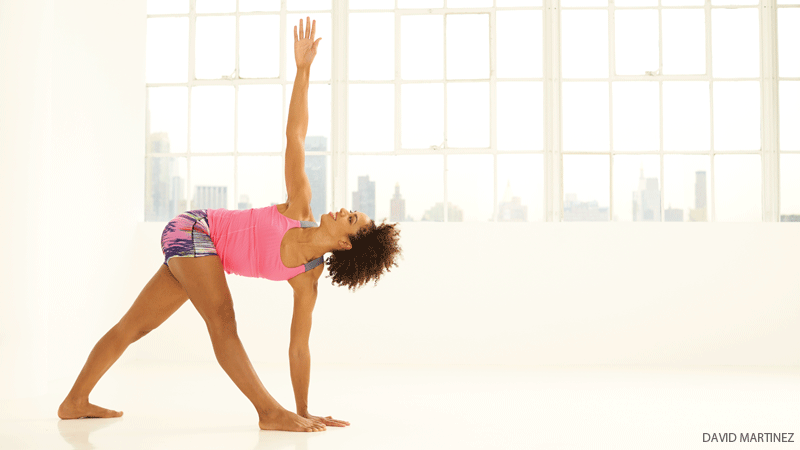
Revolved triangle pose, left arm behind right foot
Parivritta Trikonasana left
Intermediate Level

Put your feet at the length of your leg. Stretch your arms to your sides. Rotate your right foot 90 degrees and your left foot by about 15 degrees to the right. Rotate your pelvis and torso as much to the right as you can, lower your torso parallel to the floor. Move your left arm behind your right leg. Try to put your hand behind your right foot keeping legs straight. Try to keep your torso straight, not to lower it. Stretch your right arm up. Try to look up at your hand.

No Comments Pose for the week

Pose for the week

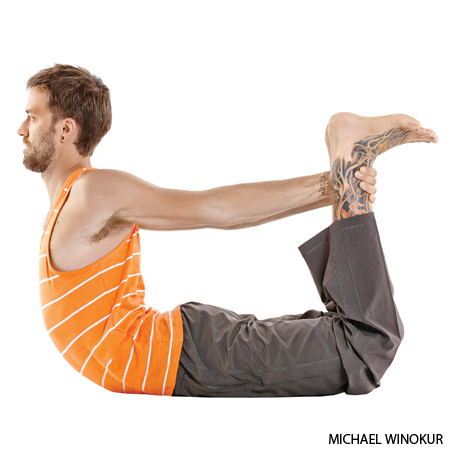
Dhanurasana (Bow Pose): Step-by-Step Instructions

This pose is so called because it looks like an archer’s bow, the torso and legs representing the body of the bow, and the arms the string.

(don-your-AHS-anna)
dhanu = bow

Lie on your belly with your hands alongside your torso, palms up. (You can lie on a folded blanket to pad the front of your torso and legs.) Exhale and bend your knees, bringing your heels as close as you can to your buttocks. Reach back with your hands and take hold of your ankles (but not the tops of the feet). Make sure your knees aren’t wider than the width of your hips, and keep your knees hip width for the duration of the pose.

See also Stop Slouching! Improve Posture in Bow Pose

Inhale and strongly lift your heels away from your buttocks and, at the same time, lift your thighs away from the floor. This will have the effect of pulling your upper torso and head off the floor. Burrow the tailbone down toward the floor, and keep your back muscles soft. As you continue lifting the heels and thighs higher, press your shoulder blades firmly against your back to open your heart. Draw the tops of the shoulders away from your ears. Gaze forward.

See also Nix Neck Pain in Camel Pose

With the belly pressed against the floor, breathing will be difficult. Breathe more into the back of your torso, and be sure not to stop breathing.

See also More Chest Opening Yoga Poses

Stay in this pose anywhere from 20 to 30 seconds. Release as you exhale, and lie quietly for a few breaths. You can repeat the pose once or twice more

No Comments Pose for the week

Pose for the week

(vip-par-ee-tah car-AHN-ee)
viparita = turned around, reversed, inverted
karani = doing, making, action
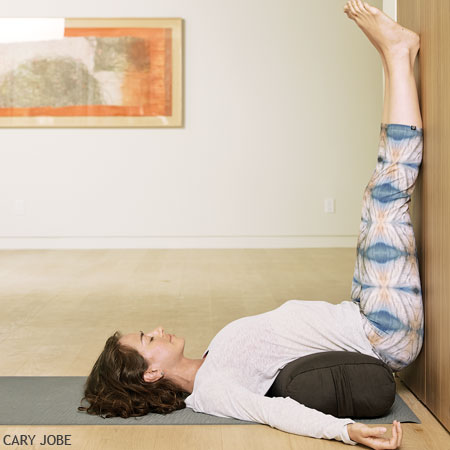
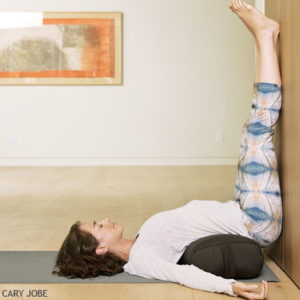
Legs-Up-The-Wall Pose: Step-by-Step Instructions

The pose described here is a passive, supported variation of the Shoulderstand-like Viparita Karani. For your support you’ll need one or two thickly folded blankets or a firm round bolster. You’ll also need to rest your legs vertically (or nearly so) on a wall or other upright support.

Before performing the pose, determine two things about your support: its height and its distance from the wall. If you’re stiffer, the support should be lower and placed farther from the wall; if you’re more flexible, use a higher support that is closer to the wall. Your distance from the wall also depends on your height: if you’re shorter move closer to the wall, if taller move farther from the wall. Experiment with the position of your support until you find the placement that works for you.

See also Do Less, Relax More

Start with your support about 5 to 6 inches away from the wall. Sit sideways on right end of the support, with your right side against the wall (left-handers can substitute “left” for “right” in these instructions). Exhale and, with one smooth movement, swing your legs up onto the wall and your shoulders and head lightly down onto the floor. The first few times you do this, you may ignominiously slide off the support and plop down with your buttocks on the floor. Don’t get discouraged. Try lowering the support and/or moving it slightly further off the wall until you gain some facility with this movement, then move back closer to the wall.

For More Restorative Yoga Poses

Your sitting bones don’t need to be right against the wall, but they should be “dripping” down into the space between the support and the wall. Check that the front of your torso gently arches from the pubis to the top of the shoulders. If the front of your torso seems flat, then you’ve probably slipped a bit off the support. Bend your knees, press your feet into the wall and lift your pelvis off the support a few inches, tuck the support a little higher up under your pelvis, then lower your pelvis onto the support again.

See also Survival Strategy

Lift and release the base of your skull away from the back of your neck and soften your throat. Don’t push your chin against your sternum; instead let your sternum lift toward the chin. Take a small roll (made from a towel for example) under your neck if the cervical spine feels flat. Open your shoulder blades away from the spine and release your hands and arms out to your sides, palms up.

Keep your legs relatively firm, just enough to hold them vertically in place. Release the heads of the thigh bones and the weight of your belly deeply into your torso, toward the back of the pelvis. Soften your eyes and turn them down to look into your heart.

See also Poses for Headaches

Stay in this pose anywhere from 5 to 15 minutes. Be sure not to twist off the support when coming out. Instead, slide off the support onto the floor before turning to the side. You can also bend your knees and push your feet against the wall to lift your pelvis off the support. Then slide the support to one side, lower your pelvis to the floor, and turn to the side. Stay on your side for a few breaths, and come up to sitting with an exhalation.
No Comments Pose for the week

Poses

Hero Pose

(veer-AHS-anna)

vira = man, hero, chief
Hero Pose: Step-by-Step Instructions

Kneel on the floor (use a folded blanket or bolster to wedge between your calves and thighs if necessary), with your thighs perpendicular to the floor, and touch your inner knees together. Slide your feet apart, slightly wider than your hips, with the tops of the feet flat on the floor. Angle your big toes slightly in toward each other and press the top of each foot evenly on the floor.

For More Seated Poses

Exhale and sit back halfway, with your torso leaning slightly forward. Wedge your thumbs into the backs of your knees and draw the skin and flesh of the calf muscles toward the heels. Then sit down between your feet.

Watch This Video on Hero Pose

If your buttocks don’t comfortably rest on the floor, raise them on a block or thick book placed between the feet. Make sure both sitting bones are evenly supported. Allow a thumb’s-width space between the inner heels and the outer hips. Turn your thighs inward and press the heads of the thigh bones into the floor with the bases of your palms. Then lay your hands in your lap, one on the other, palms up, or on your thighs, palms down.

Firm your shoulder blades against the back ribs and lift the top of your sternum like a proud warrior. Widen the collarbones and release the shoulder blades away from the ears. Lengthen the tailbone into the floor to anchor the back torso.

See also: Give Yourself Props in Hero Pose

At first stay in this pose from 30 seconds to 1 minute. Gradually extend your stay up to 5 minutes. To come out, press your hands against the floor and lift your buttocks up, slightly higher than the heels. Cross your ankles underneath your buttocks, sit back over the feet and onto the floor, then stretch your legs out in front of you. It may feel good to bounce your knees up and down a few times on the floor.

No Comments Pose for the week

Pose for the week

Upward Plank Pose: Step-by-Step Instructions

Sit in Dandasana (Staff Pose) with your hands several inches behind your hips and your fingers pointing forward. Bend your knees and place your feet on the floor, big toes turned inward, heels at least a foot away from your buttocks.

See also How to Get More Vertical in Plank Pose

Exhale, press your inner feet and hands down against the floor, and lift your hips until you come into a reverse tabletop position, torso and thighs approximately parallel to the floor, shins and arms approximately perpendicular.

See also More Poses for Building Strength

Without losing the height of your hips, straighten your legs one at a time. Lift your hips still higher without hardening your buttocks. Press your shoulder blades against your back torso to support the lift of your chest.

Without compressing the back of your neck, slowly drop your head back.

See also Poses to Build Core Strength

Hold for 30 seconds, then sit back down in Dandasana with an exhale.

No Comments Pose for the week

Pose for the week

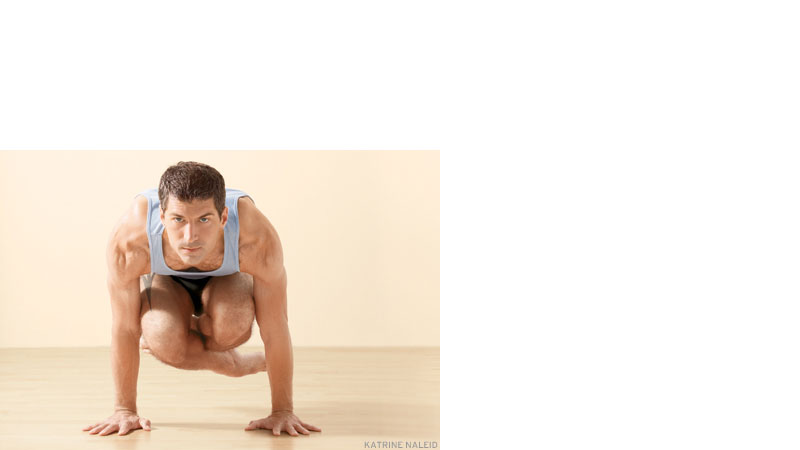
Hard-Core Arm Balance: Lolasana

Lolasana is called Pendant Pose for a reason: The body really dangles and even swings a little bit. The foundation of the pose is the hands; the rib cage hangs from the upper arms and shoulders; the spine and pelvis hang from the rib cage; and the legs hang from the spine and pelvis. The pose is highly effective for strengthening all of the abdominal muscles, most of the hip flexors, and several shoulder muscles, but it puts extraordinary demands on the external oblique abdominals, making it especially powerful for strengthening the sides of the waist.

To get an intuitive sense of the muscles involved, sit in a sturdy chair, put your hands on the seat on either side of your hips, lean forward about 45 degrees, and push down firmly to take most of the weight off your pelvis. At first, relax your abdomen and hips, allowing your pelvis and legs to hang down so all the work is in your arms, chest, and shoulders. Notice that the triceps muscles on the backs of your upper arms tighten to straighten your elbows, and two other muscle groups—the pectorals, on the front of your chest, and the serratus anterior muscles, which run from your inner shoulder blades to your side ribs in front of your armpits—work together to lift your rib cage upward. This upward pull tends to make your ribs swing up and away from your dangling pelvis, similar to the movement they make when you inhale deeply.

No Comments Pose for the week

Pose for the week

(chaht-tour-ANG-ah don-DAHS-anna)
chaturanga = four limbs (chatur = four
anga = limb)
danda = staff (refers to the spine, the central “staff” or support of the body)

Step by Step

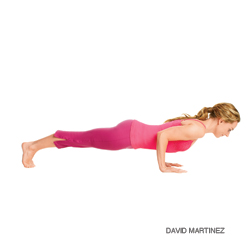
Perform Adho Mukha Svanasana, then Plank Pose. Firm your shoulder blades against your back ribs and press your tailbone toward your pubis.

With an exhalation slowly lower your torso and legs to a few inches above and parallel to the floor. There’s a tendency in this pose for the lower back to sway toward the floor and the tailbone to poke up toward the ceiling. Throughout your stay in this position, keep the tailbone firmly in place and the legs very active and turned slightly inward. Draw the pubis toward the navel.

Keep the space between the shoulder blades broad. Don’t let the elbows splay out to the sides; hold them in by the sides of the torso and push them back toward the heels. Press the bases of the index fingers firmly to the floor. Lift the top of the sternum and your head to look forward.

Chaturanga Dandasana is one of the positions in the Sun Salutation sequence. You can also practice this pose individually for anywhere from 10 to 30 seconds. Release with an exhalation. Either lay yourself lightly down onto the floor or push strongly back to Adho Mukha Svanasana, lifting through the top thighs and the tailbone.

No Comments Pose for the week

Pose for the week

Savasana
Corpse pose

Lie on your back. Stretch your backbone on the floor, helping with your hands. Straighten your legs, your toes relaxed and pointing outward. Put your arms along your torso with your palms up, your shoulders pressed to the floor. Close your eyes and relax. Try to calm your breath and mind as much as you can.

No Comments Pose for the week

Yoga Pose

Warrior III Pose
Virabhadrasana III

(veer-ah-bah-DRAHS-anna)

Virabhadra = the name of a fierce warrior, an incarnation of Shiva, described as having a thousand heads, a thousand eyes, and a thousand feet; wielding a thousand clubs; and wearing a tiger’s skin.

Step by Step

Stand in Tadasana, exhale and fold foward to Uttanasana. From Uttanasana, exhale and step your left foot back into a high lunge position. Your right knee should be more or less at a right angle. Lay the midline of your torso (from the pubis to the sternum) down on the midline of the right thigh (from the knee to the hip crease) and bring your hands to your right knee, right hand to the outer knee, left hand to the inner. Squeeze the knee with your hands, lift your torso slightly, and with an exhalation, turn it slightly to the right.

Now from the lunge position, stretch your arms forward, parallel to the floor and parallel to each other, palms facing each other. Exhale and press the head of the right thighbone back and press the heel actively into the floor. Synchronize the straightening of the front leg and the lifting of the back leg. As you lift the back leg, resist by pressing the tailbone into the pelvis.

Normally students come up into Virabhadrasana III by lunging the torso forward. This tends to shift the body weight onto the ball of the front foot and unbalance the position. Don’t allow the torso to swing forward as you move into position; instead, as you straighten the front knee, think of pressing the head of the thighbone back. This centers the femur in the hip joint, grounds the heel into the floor, and stabilizes the position.

The arms, torso, and raised leg should be positioned relatively parallel to the floor. For many students the pelvis tends to tilt. Release the hip [of the raised leg] toward the floor until the two hip points are even and parallel to the floor. Energize the back leg and extend it strongly toward the wall behind you; reach just as actively in the opposite direction with the arms. Bring the head up slightly and look forward, but be sure not to compress the back of your neck.

Stay in this position for 30 seconds to a minute. Release back to the lunge on an exhalation. Bring your hands to the floor on either side of the right foot, and on an exhalation, step your left foot forward to meet your right. Stay in this forward bend for a few breaths, then repeat for the same length of time on the other side.

No Comments Pose for the week

Pose for the week

Big Toe Pose
Padangusthasana

Step by Step

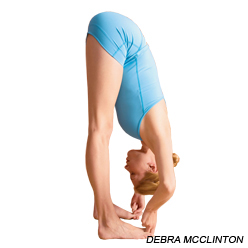
Stand upright with your inner feet parallel and about six inches apart. Contract your front thigh muscles to lift your kneecaps. Keeping your legs completely straight, exhale and bend forward from your hip joints, moving your torso and head as one unit.

Slide the index and middle fingers of each hand between the big toes and the second toes. Then curl those fingers under and grip the big toes firmly, wrapping the thumbs around the other two fingers to secure the wrap. Press your toes down against your fingers. (If you can’t reach your toes without overly rounding your back, pass a strap under the ball of each foot and hold the straps.)

With an inhalation, lift your torso as if you were going to stand up again, straightening your elbows. Lengthen your front torso, and on the next exhale, lift your sitting bones. Depending on your flexibility, your lower back will hollow to a greater or lesser degree. As you do this, release your hamstrings and hollow your lower belly (below your navel) as well, lightly lifting it toward the back of your pelvis.

Lift the top of your sternum as high as you can, but take care not to lift your head so far that you compress the back of your neck. Keep your forehead relaxed.

For the next few inhalations, lift your torso strongly as you continue to actively contract your front thighs; on each successive exhalation, strongly lift your sitting bones as you consciously relax your hamstrings. As you do this, deepen the hollow in your lower back.

Finally exhale, bend your elbows out to the sides, pull up on your toes, lengthen the front and sides of your torso, and gently lower into the forward bend.

If you have very long hamstrings, you can draw your forehead toward your shins. But if your hamstrings are short, it’s better to focus on keeping the front torso long. Hunching into a forward bend isn’t safe for your lower back and does nothing to lengthen your hamstrings.

Hold the final position for one minute. Then release your toes, bring your hands to your hips, and re-lengthen your front torso. With an inhale, swing your torso and head as a single unit back to upright..

No Comments Pose for the week