Asana for the week

SidePlankPose

Side Plank Pose

The full version of Vasisthasana, as taught by BKS Iyengar, with the top leg raised perpendicular to the floor, is beyond the capacity of most beginners. The pose described here is a modified version suitable for all levels of students.

(vah-sish-TAHS-anna)

Vasistha = literally means “most excellent, best, richest.” Vasistha is the name of several well-known sages in the yoga tradition. There’s a Vasistha numbered among the seven (sometimes 10 or 12) seers (rishis) or lords of creation (prajapatis), and a Vasistha who’s author of a number of Vedic hymns. He’s also said to be the owner of the fabulous “cow of plenty,” Nandini (“delight”), which grants his every wish and accounts for his infinite wealth.
Side Plank Pose: Step-by-Step Instructions

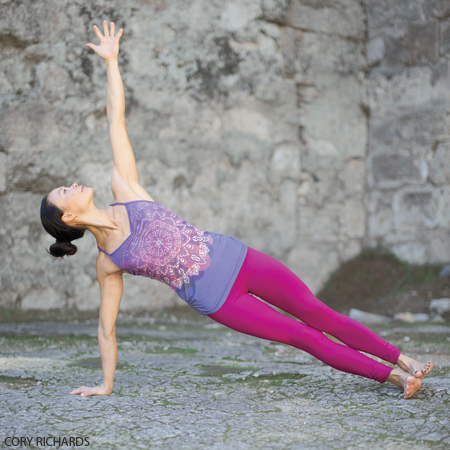
Perform Adho Mukha Svanasana. Shift onto the outside edge of your left foot, and stack your right foot on top of the left. Now swing your right hand onto your right hip, turn your torso to the right as you do, and support the weight of your body on the outer left foot and left hand.

Make sure that the supporting hand isn’t directly below its shoulder; position the hand slightly in front of its shoulder, so the supporting arm is angled a bit relative to the floor. Straighten the arm by firming the triceps muscle, and press the base of the index finger firmly against the floor.

Firm the scapulas and sacrum against the back torso. Strengthen the thighs, and press through the heels toward the floor. Align your entire body into one long diagonal line from the heels to the crown.

If you’d like you can stretch the top arm toward the ceiling, parallel to the line of the shoulders. Keep the head in a neutral position, or turn it to gaze up at the top hand.

Stay in this position for 15 to 30 seconds. Come back to Adho Mukha Svanasana, take a few breaths, and repeat to the right side for the same length of time. Then return to Adho Mukha Svanasana for a few more breaths, and finally release into Balasana.
Pose for the week

Pose for the week

boatpose

Boat Pose

(par-ee-POOR-nah nah-VAHS-anna)
paripurna = full, entire, complete
nava = boat

Step by Step

Sit on the floor with your legs straight in front of you. Press your hands on the floor a little behind your hips, fingers pointing toward the feet, and strengthen the arms. Lift through the top of the sternum and lean back slightly. As you do this make sure your back doesn’t round; continue to lengthen the front of your torso between the pubis and top sternum. Sit on the “tripod” of your two sitting bones and tailbone.

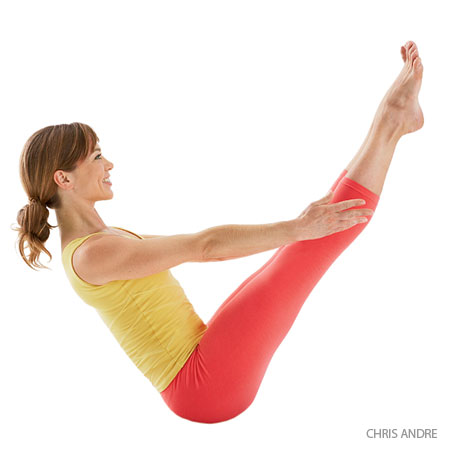
Exhale and bend your knees, then lift your feet off the floor, so that the thighs are angled about 45-50 degrees relative to the floor. Lengthen your tailbone into the floor and lift your pubis toward your navel. If possible, slowly straighten your knees, raising the tips of your toes slightly above the level of your eyes. If this isn’t possible remain with your knees bent, perhaps lifting the shins parallel to the floor.

Stretch your arms alongside the legs, parallel to each other and the floor. Spread the shoulder blades across your back and reach strongly out through the fingers. If this isn’t possible, keep the hands on the floor beside your hips or hold on to the backs of your thighs.

While the lower belly should be firm, it shouldn’t get hard and thick. Try to keep the lower belly relatively flat. Press the heads of the thigh bones toward the floor to help anchor the pose and lift the top sternum. Breathe easily. Tip the chin slightly toward the sternum so the base of the skull lifts lightly away from the back of the neck.

Pose for the week

Asana for the week

lordofthefisheshalf

Half Lord of the Fishes Pose

(ARE-dah MOT-see-en-DRAHS-anna) ardha = half Matsyendra = king of the fish (matsya = fish indra = ruler), a legendary teacher of yoga
Half Lord of the Fishes Pose: Step-by-Step Instructions

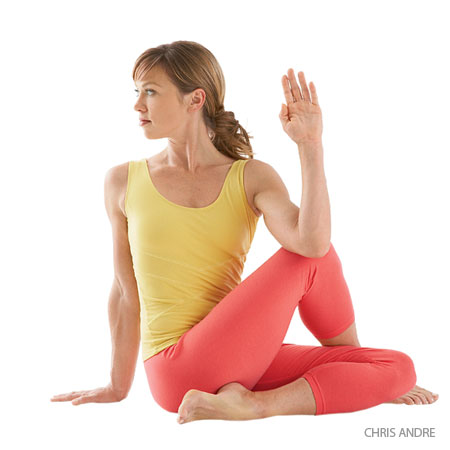
Sit on the floor with your legs straight out in front of you, buttocks supported on a folded blanket. Bend your knees, put your feet on the floor, then slide your left foot under your right leg to the outside of your right hip. Lay the outside of the left leg on the floor. Step the right foot over the left leg and stand it on the floor outside your left hip. The right knee will point directly up at the ceiling.

Exhale and twist toward the inside of the right thigh. Press the right hand against the floor just behind your right buttock, and set your left upper arm on the outside of your right thigh near the knee. Pull your front torso and inner right thigh snugly together.

Press the inner right foot very actively into the floor, release the right groin, and lengthen the front torso. Lean the upper torso back slightly, against the shoulder blades, and continue to lengthen the tailbone into the floor.

You can turn your head in one of two directions: Continue the twist of the torso by turning it to the right; or counter the twist of the torso by turning it left and looking over the left shoulder at the right foot.

With every inhalation lift a little more through the sternum, pushing the fingers against the floor to help. Twist a little more with every exhalation. Be sure to distribute the twist evenly throughout the entire length of the spine; don’t concentrate it in the lower back. Stay for 30 seconds to 1 minute, then release with an exhalation, return to the starting position, and repeat to the left for the same length of time. Watch a video demonstration of this pose.

Pose for the week

Pose for the week

HP_269_FNL_81159

Revolved Triangle Pose

(par-ee-vrit-tah trik-cone-AHS-anna)
parivrtta = to turn around, revolve
trikona = three angle or triangle
Revolved Triangle Pose: Step-by-Step Instructions

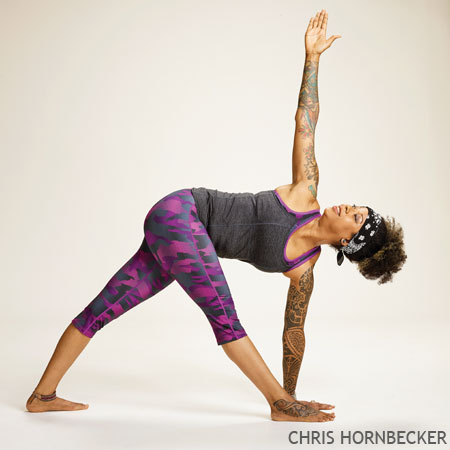
Stand in Tadasana. With an exhalation, step or lightly jump your feet 3½ to 4 feet apart. Raise your arms parallel to the floor and reach them actively out to the sides, shoulder blades wide, palms down. Turn your left foot in 45 to 60 degrees to the right and your right foot out to the right 90 degrees. Align the right heel with the left heel. Firm your thighs and turn your right thigh outward, so that the center of the right kneecap is in line with the center of the right ankle.

With an exhalation, turn your torso to the right, and square your hip points as much as possible with the front edge of your sticky mat. As you bring the left hip around to the right, resist the head of the left thigh bone back and firmly ground the left heel.

With another exhalation, turn your torso further to the right and lean forward over the front leg. Reach your left hand down, either to the floor (inside or outside the foot) or, if the floor is too far away, onto a block positioned against your inner right foot. Allow the left hip to drop slightly toward the floor. You may feel the right hip slip out to the side and lift up toward the shoulder, and the torso hunch over the front leg. To counteract this, press the outer right thigh actively to the left and release the right hip away from the right shoulder. Use your right hand, if necessary, to create these two movements, hooking the thumb into the right hip crease.

See also More Poses for Strength

Beginning students should keep their head in a neutral position, looking straight forward, or turn it to look at the floor. More experienced students can turn the head and gaze up at the top thumb. From the center of the back, between the shoulder blades, press the arms away from the torso. Bring most of your weight to bear on the back heel and the front hand.

Stay in this pose anywhere from 30 seconds to one minute. Exhale, release the twist, and bring your torso back to upright with an inhalation. Repeat for the same length of time with the legs reversed, twisting to the left.

Pose for the week

Asana for the week

hp_10

Wide-Legged Forward Bend

(pra-sa-REE-tah pah-doh-tahn-AHS-anna)
prasarita = stretched out, expanded, spread, with outstretched limbs
pada = foot
ut = intense
tan = to stretch or extend (compare the Latin verb tendere, “to stretch or extend”)
Wide-Legged Forward Bend: Step-by-Step Instructions

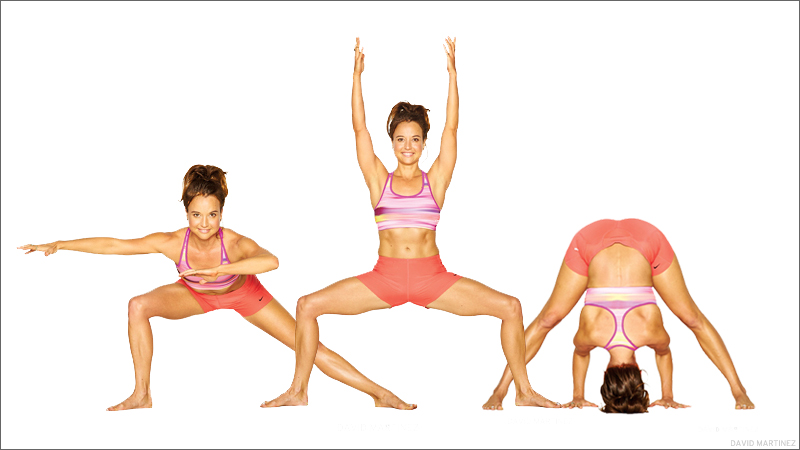
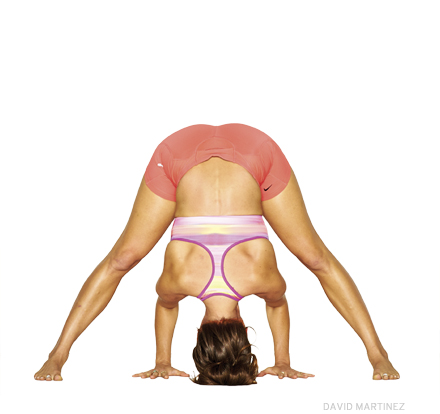
Stand in Tadasana (Mountain Pose), facing one of the long edges of your sticky mat, then step or lightly hop your feet apart anywhere from 3 to 4 1/2 feet (depending on your height: taller people should step wider). Rest your hands on your hips. Make sure your inner feet are parallel to each other. Lift your inner arches by drawing up on the inner ankles, and press the outer edges of your feet and ball of the big toe firmly into the floor. Engage the thigh muscles by drawing them up. Inhale and lift your chest, making the front torso slightly longer than the back.

Exhale and, maintaining the length of the front torso, lean the torso forward from the hip joints. As your torso approaches parallel to the floor, press your fingertips onto the floor directly below your shoulders. Extend your elbows fully. Your legs and arms then should be perpendicular to the floor and parallel to each other. Move your spine evenly into the back torso so that your back is slightly concave from the tailbone to the base of the skull. Bring your head up, keeping the back of the neck long, and direct your gaze upward toward the ceiling.

Push your top thighs straight back to help lengthen the front torso, and draw the inner groins away from each other to widen the base of your pelvis. Take a few breaths. As you maintain the concavity of your back and the forward lift of your sternum, walk your fingertips between your feet. Take a few more breaths and then, with an exhalation, bend your elbows and lower your torso and head into a full forward bend. Make sure as you move down that you keep your front torso as long as possible. If possible rest the crown of your head on the floor.

Press your inner palms actively into the floor, fingers pointing forward. If you have the flexibility to move your torso into a full forward bend, walk your hands back until your forearms are perpendicular to the floor and your upper arms parallel. Be sure to keep your arms parallel to each other and widen the shoulder blades across the back. Draw your shoulders away from your ears.

Stay in the pose anywhere from 30 seconds to 1 minute. To come out, bring your hands back on the floor below your shoulders and lift and lengthen your front torso. Then with an inhalation, rest your hands on your hips, pull your tail bone down toward the floor, and swing the torso up. Walk or hop your feet back into Tadasana.

Pose for the week

Asana for the week

garden_228_03_4501

Bound Angle Pose

(BAH-dah cone-AHS-anna)
baddha = bound
kona = angle
Bound Angle Pose: Step-by-Step Instructions

Step by Step

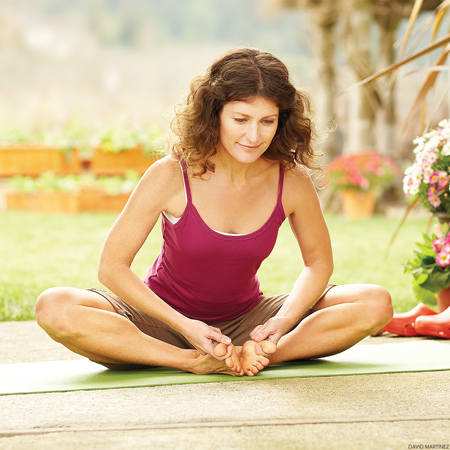
Sit with your legs straight out in front of you, raising your pelvis on a blanket if your hips or groins are tight. Exhale, bend your knees, pull your heels toward your pelvis, then drop your knees out to the sides and press the soles of your feet together.

Bring your heels as close to your pelvis as you comfortably can. With the first and second finger and thumb, grasp the big toe of each foot. Always keep the outer edges of the feet firmly on the floor. If it isn’t possible to hold the toes, clasp each hand around the same-side ankle or shin.

Sit so that the pubis in front and the tailbone in back are equidistant from the floor. The perineum then will be approximately parallel to the floor and the pelvis in a neutral position. Firm the sacrum and shoulder blades against the back and lengthen the front torso through the top of the sternum.

Never force your knees down. Instead release the heads of the thigh bones toward the floor. When this action leads, the knees follow.

Stay in this pose anywhere from 1 to 5 minutes. Then inhale, lift your knees away from the floor, and extend the legs back to their original position.

Pose for the week

Pose for the week

mc_239_05_fnl-credit

Peak Form: 5 Steps to Ardha Chandra Chapasana

By carefully carving a pathway to Ardha Chandra Chapasana, you’ll reach new heights in your body and mind.

If Ardha Chandra Chapasana is the peak you’re eyeing, says Power Yoga teacher Baron Baptiste, each step on the path must be mastered before you can get to the top. A powerful heart opener, this challenging variation of Half Moon Pose offers both a balancing posture and an asymmetrical backbend. Baptiste, founder of the Baptiste Power Yoga Institute, says it’s the taste of freedom he experiences when practicing precision with a sincere willingness to be open to new physical possibilities that keeps him coming back to Ardha Chandra Chapasana year after year.

But ascending to the peak of any pose requires a steady foundation. The key to feeling the freedom Baptiste is speaking of, in your day-to-day practice as well as in the peak pose, lies in giving detailed attention to the integrity of your alignment in every moment of every pose. What at first might seem confining or even tedious—this detailed attention to the placement of a hand or the toes—is what will ultimately provide the integrity for the body, and therefore the spirit, to soar in the final backbend. “Precision gives access to integration in a way that keeps you safe and supported,” says Baptiste. “When you work with precision, you create the space to explore what’s possible in your body, which keeps your practice energized instead of static.”

Baptiste recommends approaching this sequence like a climber ascending a peak with multiple pitches: At each natural pause in the ascent, ask yourself, “Am I on firm enough ground to continue? Do I feel secure? Do I feel supported?” Then, as you move through each pose in the sequence, stop to regroup, check your “safety gear,” and reestablish your composure. Take the time to check and recheck the places in your body and psyche that might be vulnerable to injury or weakness. Make an extra effort to keep those areas open and supported, firm yet free.

Keep in mind that precision is different from perfectionism. By Baptiste’s definition, working precisely requires mindfulness of action. When you move mindfully on your mat and when you use precision to create stability in your poses, you begin to carve the pathway that takes you to new heights in your practice. And when you witness the benefits of working with precision on your mat, Baptiste believes that you will feel empowered to make positive changes in your life, too. “The power to change your body through yoga creates confidence in your ability to change your life in ways you didn’t think possible,” says Baptiste. “With a mindful, conscious practice, you can connect with your personal power, your ability to change your life.”

Perfectionism, on the other hand, is rife with self-criticism and judgment. Begin to cast judgment on your pose, your practice, or yourself as “right” or “wrong,” and the ledge you’re on can expand into a never-ending plateau of self-doubt. When you aspire to create “perfect” poses, you miss out on witnessing the fullness of each moment—whether positive or negative. Precision is about process. Perfectionism occurs when you believe the myth that there is an endpoint in your yoga practice.

In this adventurous sequence leading to Ardha Chandra Chapasana, you’ll explore a liberating approach to balance, backbending, and hip opening. Take action with precision—moving body and mind with care and confidence—and you’ll find there’s more space to explore the possibilities of this pose than you imagined.

Pose for the week

Pose for the week

pract-well_trail_268_02_FNLTadasana

Mountain Pose

(tah-DAHS-anna)
tada = mountain
Mountain Pose: Step-by-Step Instructions

Stand with the bases of your big toes touching, heels slightly apart (so that your second toes are parallel). Lift and spread your toes and the balls of your feet, then lay them softly down on the floor. Rock back and forth and side to side. Gradually reduce this swaying to a standstill, with your weight balanced evenly on the feet.

Firm your thigh muscles and lift the knee caps, without hardening your lower belly. Lift the inner ankles to strengthen the inner arches, then imagine a line of energy all the way up along your inner thighs to your groins, and from there through the core of your torso, neck, and head, and out through the crown of your head. Turn the upper thighs slightly inward. Lengthen your tailbone toward the floor and lift the pubis toward the navel.

Press your shoulder blades into your back, then widen them across and release them down your back. Without pushing your lower front ribs forward, lift the top of your sternum straight toward the ceiling. Widen your collarbones. Hang your arms beside the torso.

Balance the crown of your head directly over the center of your pelvis, with the underside of your chin parallel to the floor, throat soft, and the tongue wide and flat on the floor of your mouth. Soften your eyes.

Tadasana is usually the starting position for all the standing poses. But it’s useful to practice Tadasana as a pose in itself. Stay in the pose for 30 seconds to 1 minute, breathing easily.

Pose for the week

Pose for the week

HP_AM06_02_195

Low Lunge

Low Lunge: Step-by-Step Instructions

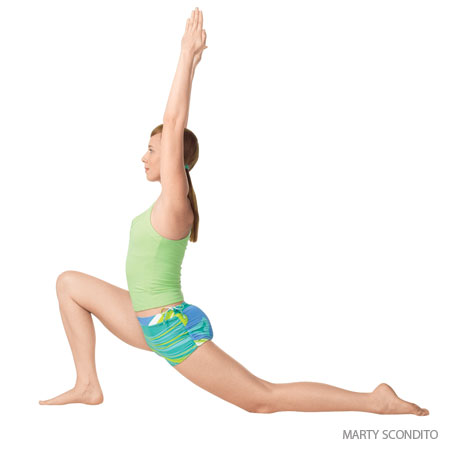
From Downward-Facing Dog (Adho Mukha Svanasana), exhale and step your right foot forward between your hands, aligning the right knee over the heel. Then lower your left knee to the floor and, keeping the right knee fixed in place, slide the left back until you feel a comfortable stretch in the left front thigh and groin. Turn the top of your left foot to the floor.

Inhale and lift your torso to upright. As you do, sweep your arms out to the sides and up, perpendicular to the floor. Draw the tailbone down toward the floor and lift your pubic bone toward your navel. Lift your chest from the firmness of your shoulder blades against the back torso.

Take your head back and look up, being careful not to jam the back of your neck. Reach your pinkies toward the ceiling. Hold for a minute, exhale your torso back to the right thigh and your hands to the floor, and turn your back toes under. With another exhale, lift your left knee off the floor and step back to Adho Mukha Svanasana. Repeat with the left foot forward for the same length of time.

Pose for the week