Poem
18
Dec
2014


Hero Pose
(veer-AHS-anna)
vira = man, hero, chief
Hero Pose: Step-by-Step Instructions
Kneel on the floor (use a folded blanket or bolster to wedge between your calves and thighs if necessary), with your thighs perpendicular to the floor, and touch your inner knees together. Slide your feet apart, slightly wider than your hips, with the tops of the feet flat on the floor. Angle your big toes slightly in toward each other and press the top of each foot evenly on the floor.
For More Seated Poses
Exhale and sit back halfway, with your torso leaning slightly forward. Wedge your thumbs into the backs of your knees and draw the skin and flesh of the calf muscles toward the heels. Then sit down between your feet.
Watch This Video on Hero Pose
If your buttocks don’t comfortably rest on the floor, raise them on a block or thick book placed between the feet. Make sure both sitting bones are evenly supported. Allow a thumb’s-width space between the inner heels and the outer hips. Turn your thighs inward and press the heads of the thigh bones into the floor with the bases of your palms. Then lay your hands in your lap, one on the other, palms up, or on your thighs, palms down.
Firm your shoulder blades against the back ribs and lift the top of your sternum like a proud warrior. Widen the collarbones and release the shoulder blades away from the ears. Lengthen the tailbone into the floor to anchor the back torso.
See also: Give Yourself Props in Hero Pose
At first stay in this pose from 30 seconds to 1 minute. Gradually extend your stay up to 5 minutes. To come out, press your hands against the floor and lift your buttocks up, slightly higher than the heels. Cross your ankles underneath your buttocks, sit back over the feet and onto the floor, then stretch your legs out in front of you. It may feel good to bounce your knees up and down a few times on the floor.
Bird of Paradise: 5 Steps to Master this Standing Pose
Benefit
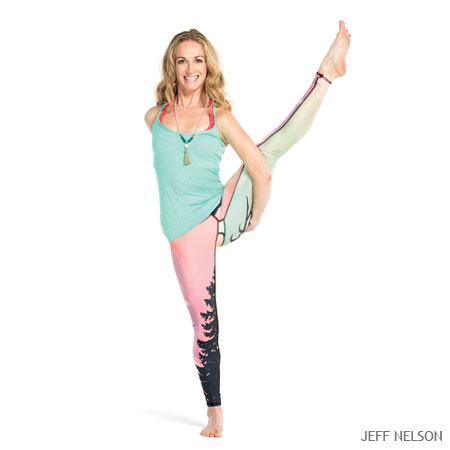
A challenging balance that incorporates hip opening, core and back strengthening, and hamstring lengthening
Instruction
1. Start in Warrior Pose II, with a bent left leg, right foot turned in slightly, and a firm, straight back leg. Inhale and take your arms to shoulder height. Exhale and bring your left arm under the left thigh, and your right arm to the sky, then behind your back. Clasp the left wrist with the right hand. Keeping the left leg bent, twist the torso to the sky as you gently press the hips forward. Your drishti is over your right shoulder as you settle into Baddha Utthita Parsvakonasana, or Bound Extended Side Angle Pose.
Yogapedia Dec 14 Bound Extended Side Angle Pose Baddha Utthita Parsvakonasana
2. Exhale and look down. Turn both your feet parallel and then carefully start to move them toward one another. Once the legs are close to hip distance, straighten them both and twist your torso to the right, keeping the bind and finding Baddha Uttanasana, or Bound Standing Forward Bend.
Yogapedia Dec 14 Bound Standing Forward Bend
3. Pour all of your weight into your right foot and start to lift your torso, bringing the left leg off the floor. Keep the supporting foot’s toes spread; your weight should be evenly distributed between the big toe, little toe, and inner and outer heel, maintaining 4 points of balance. Keep the lifted leg bent in this Svarga Dvijasana variation—Bird of Paradise with a bent leg.
Yogapedia Dec 14 Bird of Paradise Variation
4. Open the chest and extend the lifted leg to the side, being careful not to swing the supporting hip out to the side. You’re aiming to find stability and ease in equal measure. Open your chest proudly, engaging the muscles across your back to hold your heart high. If you start to teeter, revert to a bent left leg and regain stability in the right leg by pressing evenly into all four corners of the standing foot and visualizing a line down the middle of the body that you are hugging into.
Yogapedia Dec 14 Bird of Paradise
5. Fix the drishti straight ahead or over the right shoulder and stay for 5–10 deep breaths, embodying the beauty, stability, and vibrancy of the Bird of Paradise flower.
Stay safe
If the central axis of the body becomes displaced, you may compromise the knee and hip joints. Aim to keep the supporting foot facing forward, toes spread, with the knee over the ankle, and the supporting hip plugged into the midline. Keep the quadriceps on both legs contracted, allowing the standing leg to support you more fully and the hamstrings on the extended leg to open further without strain.
Thai Nguyen Become a fan
Lover of Words, Spiritual Teacher, International Kickboxer, 5-Star Chef, TheUtopianLife.com
Eeyore: A Pessimist’s Guide to a Beautiful Life
I’m a recovering pessimist. A perennial one. I know it’s a striking confession given the nature of my site. But in a paradoxical way, pessimism’s been great fuel for personal growth. Pitiful dwellings on life’s miseries launch me into striving for the best possible world.
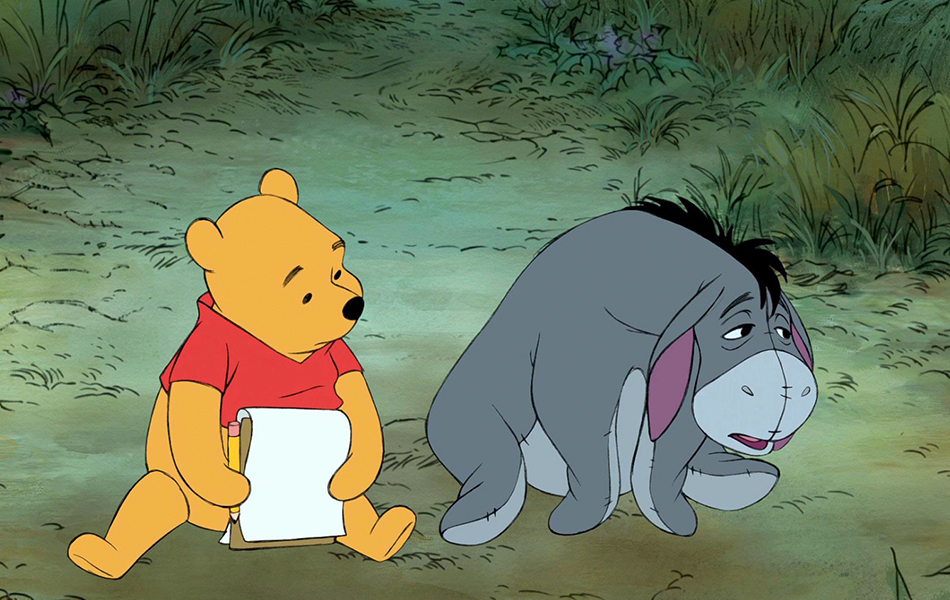
Perhaps the greatest of pessimists: Eeyore. The thistle eating donkey from A. A. Milne’s Winnie the Pooh.
There’s something poignantly oxymoronic about Eeyore — that such laughter and joy can come from a gloomy character.
In the same way being poor teaches us to appreciate wealth, having our hearts broken teaches us to love faithfully, struggle and failure magnifies our victories — Eeyore’s melancholy in a subtle way highlights the joys in life.
Here are seven classic lines and lessons for a beautiful life from Eeyore:
1. “Thanks for noticing me.”
It’s what we all want. Beyond our physical needs, the existential cry for acknowledgment underlies everything we do.
To be noticed, to be love, to be validated.
One of Eeyore’s favorite lines highlights the power in simply acknowledging someone’s presence. Appreciating the uniqueness of their character, the serendipity that allows friends to share the same space and time. Every relationship is made up of chance occurrences which deserve some marveling.
And when silence is no longer awkward in any relationship — it’s a beautiful experience of “noticing” one another that should be celebrated.
2. “It’s snowing still,” said Eeyore gloomily.
“So it is.”
“And freezing.”
“Is it?”
“Yes,” said Eeyore. “However,” he said, brightening up a little, “we haven’t had an earthquake lately.”
We’ve all blown things out of proportion before. Our problems will expand to fill the mental space we give it, and often, we give far too much.
Psychologists call it Catastrophic Thinking, defaulting to worst case scenarios — we think getting pulled over means a night in jail. Fear is a powerful mechanism, and if untamed, it knows no boundaries.
Eeyore knows the key — the word “However” causes a mental reappraisal, a mindfulness that allows for a more rational evaluation. And actually, thinking the worst case scenario, allows us to realize how unjustified and unrealistic we’re being.
3. “A tail isn’t a tail to them, it’s just a little bit extra at the back.”
Not everyone will understand you, and that’s okay. We celebrate freedom of speech, but often get bent out of shape when someone expresses an opposing view.
Just like you can take a horse to water but not make it drink, there’s no point going blue in the face telling someone it’s a tail if all they see is “extra at the back.”
4. “To the uneducated an A is just three sticks.”
Ignorance is bliss — for those who are ignorant about bliss. Eeyore must have read some Socrates, who said, “The unexamined life is not worth living.”
Knowledge has the power to expand our human experience. To learn any language is to open up to literally a whole new world. To learn any skill increases your self-confidence, and ability to add value to someone else’s life.
Give yourself the gift of seeing more than just sticks; challenge yourself to learn one new thing each day.
5. “They’re funny things, accidents. You never have them till you’re having them.”
To live life in bubble wrap may prevent us from ever getting hurt, but it’ll certainly prevent us from ever experiencing a meaningful life.
So while we can do our best to be wise and cautious, ultimately our best is the best we can do. Accidents are indiscriminate — to try and live in prediction of them is paralyzing.
6. “A little consideration, a little thought for others, makes all the difference. Or so the say.”
Our survival mechanism means we possess an inherent selfishness. Babies will learn “mine!” as quickly as “mumma” or “daddy.”
As inherent are acts of selfishness, so too is the desire for selflessness — we’ve said it a thousand times: “It’s better to give than receive.” But kindness takes a little more effort than we’d like to admit; taking action to bridge the gap between desire and act can be an internal battle. But the possibility of making someone’s day, and even their life through what we can give should be good motivation. Even if the difference goes unnoticed.
7. “We can’t all, and some of us don’t. That’s all there is to it.”
“Can’t all what?” said Pooh, rubbing his nose.
“Gaiety. Song-and-dance. Here we go round the mulberry bush.”
It’s like being an introvert in a culture that preaches extroversion. Thankfully there’s more balance nowadays with introversion seen less as an issue to fix and more of a celebration.
But with any majority view or “cultural norm,” there’s a always the temptation to feel as though there’s something wrong with you if you don’t fit into the neat cookie cutter.
Simple, yet profound words from Eeyore: “We can’t all, and some of us don’t.” There’s beauty in being different. Cookie cutters are meant for cookies, not life.