
Asanas

255_HP_01_fnl_4501

Big Toe Pose: Step-by-Step Instructions

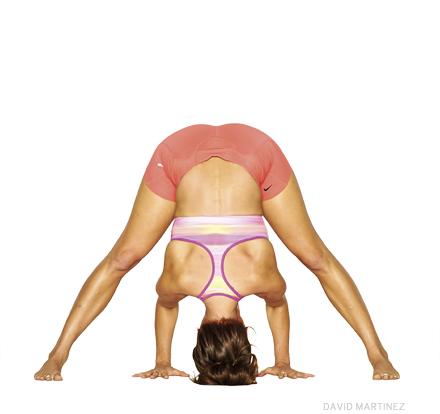
Stand upright with your inner feet parallel and about six inches apart. Contract your front thigh muscles to lift your kneecaps. Keeping your legs completely straight, exhale and bend forward from your hip joints, moving your torso and head as one unit.

Slide the index and middle fingers of each hand between the big toes and the second toes. Then curl those fingers under and grip the big toes firmly, wrapping the thumbs around the other two fingers to secure the wrap. Press your toes down against your fingers. (If you can’t reach your toes without overly rounding your back, pass a strap under the ball of each foot and hold the straps.)

See also Reclining Big Toe Pose

With an inhalation, lift your torso as if you were going to stand up again, straightening your elbows. Lengthen your front torso, and on the next exhale, lift your sitting bones. Depending on your flexibility, your lower back will hollow to a greater or lesser degree. As you do this, release your hamstrings and hollow your lower belly (below your navel) as well, lightly lifting it toward the back of your pelvis.

Lift the top of your sternum as high as you can, but take care not to lift your head so far that you compress the back of your neck. Keep your forehead relaxed.

See also Back in Traction: Reclining Hand-to-Big-Toe Pose

For the next few inhalations, lift your torso strongly as you continue to actively contract your front thighs; on each successive exhalation, strongly lift your sitting bones as you consciously relax your hamstrings. As you do this, deepen the hollow in your lower back.

Finally exhale, bend your elbows out to the sides, pull up on your toes, lengthen the front and sides of your torso, and gently lower into the forward bend.

See also More Forward Bend Yoga Poses

If you have very long hamstrings, you can draw your forehead toward your shins. But if your hamstrings are short, it’s better to focus on keeping the front torso long. Hunching into a forward bend isn’t safe for your lower back and does nothing to lengthen your hamstrings.

See also More Standing Yoga Poses

Hold the final position for one minute. Then release your toes, bring your hands to your hips, and re-lengthen your front torso. With an inhale, swing your torso and head as a single unit back to upright.

Pose for the week

image

How I Became An “Expert” Yoga Teacher Through A 20-Minute

September is National Yoga Month. So in celebration, one recent afternoon, while drinking rosé and binge-watching Friends on Netflix, I sat at my laptop, paid $69.99, and cheated on an online yoga exam. Only 20 minutes later, I was a certified yoga instructor — and with an “expert” designation to boot.

After becoming a yoga “expert,” I quickly put together a résumé, pulling phrases about my “collaborative” personality and “strong leadership skills” from a sample yoga-teacher résumé I found thanks to a cursory Google search. I didn’t embellish my experience at all; I even went out of my way to specify that I was new to teaching. Then, I sent my résumé to 16 yoga studios and gyms around New York and L.A that had posted ads for yoga teachers on Craigslist. Within a few days, 10 of these places had responded, asking me to come in for an interview.

Over the past 10 years, initiatives to regulate yoga teacher certification have failed in at least five states, most recently in Colorado. In both New York and California, there is no broadly accepted, official certification process, though many schools do seek accreditation through the Yoga Alliance, a membership organization that sets standards for and maintains a registry of schools and yoga teachers. At the same time, New York regulates the licensing of athletic trainers in the state, though California does not. The Alliance’s training standards are far more comprehensive than those required of traditional fitness professionals, with even its lowest designation of “RYT 200” requiring at least 200 hours of dedicated training. However, not all yoga teachers or schools are registered with the Yoga Alliance, and there are ways to sidestep training altogether and still become certified through non-registered programs, as I did.

Arguably, if I had actually followed through with any of the interviews, the studios would have immediately realized that I didn’t know my head from my asana and I likely wouldn’t have been hired. But to these places, at least on paper, I seemed just as qualified as any other candidate who had actually undergone legitimate training.
Photographed by Justin Namon.
Contrary to its reputation as the ultimate “chill” workout, yoga isn’t risk-free. Practicing under the supervision of a teacher who doesn’t quite know what he or she is doing can be dangerous, especially for inexperienced yogis like me. Two years ago, during an overcrowded, pay-what-you-want class in New York, I had a teacher who didn’t correct my form as I went through my sequences and I ended up with a lower-back injury that required nearly a year of time-consuming physical therapy, on and off.

Novices need experienced teachers to make modifications and let us know when we’re doing a pose wrong; without supervision, we risk moving our bodies in ways that can cause injury. Andrew Tanner, spokesperson for the Yoga Alliance, said, “A good teacher…can prevent injury and really help you get the poses. The slightest little tweak can totally change a pose and make it safer.”
For even the most seasoned practitioner, yoga can still be dangerous. Lifelong yogis can injure themselves from pushing too hard or not remaining mindful of their alignment in a given pose. Jessica F. Lillian, a registered yoga teacher in the New York area, told me that she is still dealing with a wrist injury she suffered in March while attending an arm-balance class that was taught by a celebrity yoga teacher. Lillian said she pushed herself too hard during the class, and for weeks afterwards, continued to power through the same painful poses despite knowing that she should have stopped.

After a diagnosis of traumatic tendonitis and six weeks in a brace, Lillian’s wrist still hadn’t healed. Despite yoga’s reputation as a low-impact exercise practice, its injuries can be just as severe as those from any other sport. If this could happen to a yoga instructor with over 200 hours of training, then it could easily happen to a yoga newbie who is still learning the ropes.

In fact, according to data provided to Refinery29 from the U.S. Consumer Product Safety Commission, there were 20,719 yoga-related injuries in 2013 that required both doctors’ office and emergency room visits. The National Center for Complementary and Integrative Health said in February that its National Health Interview Survey showed that 21 million adults practiced yoga in 2012 (the latest available data). So while the number of injuries is relatively low, it’s still bothersome, particularly because it doesn’t take into account minor injuries that didn’t necessitate a visit to the doctor. Comparatively, the CPSC’s National Electronic Injury Surveillance System found that in 2013 there were also an estimated 472,212 injuries from exercise (including with and without exercise equipment) that necessitated a visit to the emergency room.

“An untrained yoga instructor can compromise your alignment [and] cause unnecessary strain and injury,” explained Sarah Drescher, a registered yoga teacher in L.A. That is one reason why several states, including Arkansas, have attempted to regulate yoga teacher training. Brenda Germann, the director of the Arkansas State Board of Private Career Education, was involved in the push for government oversight of yoga teacher training in the state. She told me that she had taken yoga classes in the past with an instructor who didn’t ask if any of the students had health concerns, like pregnancy or high-blood pressure. She wanted to ensure that yoga teachers in Arkansas were adequately trained to take students’ safety into consideration. Ultimately, the Arkansas legislature opted to exclude yoga from regulation in February. “There is no consumer protection,” Germann said.
Photographed by Justin Namon.
The Yoga Alliance is vehemently against state regulation, though. “There [are] so many reasons why state regulation would not be good for yoga,” Tanner said. “First of all, it would really damage the diversity of yoga teaching and style. There’s no one-size-fits-all for yoga. It’s hard to even get teachers from different lineages to agree on what the right training practices are.” On its website, the Alliance said that state regulation wouldn’t benefit the public and that it unfairly targets the yoga community. Tanner added that even though the Alliance provides standards for schools, some excellent studios decide not to adhere to the organization’s regulations and produce stellar teachers nevertheless. “There are schools in India, for example, that are not registered with Yoga Alliance, whose standards even exceed our own. We think that if it got to the place where the government was trying to force everyone into a particular standard, it would really dilute the quality of the teachings, and it would also get in the way of the student-teacher relationship,” Tanner said.

Because there’s not a uniform set of rules or regulations governing yoga teacher training, it’s the student’s job to do due diligence before class, according to Drescher. “Anyone who is looking to do yoga should be sure [to] go somewhere with credentials. Find the vibe and the kind of class you want, but always be sure the teachers are trained and certified. It’s usually best to get a recommendation from a friend,” Drescher said.
Students can look up their teachers’ credentials on the studio’s website beforehand. Keeping an eye out for the “RYT” designation — given to Yoga Alliance members — is a good idea. But don’t reject a teacher just because he or she isn’t a member of the Alliance. Instead, take a look at the number of hours that person has trained and the school from which he or she received the certification, and determine from that if this teacher has the credibility needed to properly guide you through your practice. “The biggest risk of injury comes when people walk into a yoga class without having done any research about the teacher, about the style — and even if the teacher is qualified, they do a pose that is not right for them,” Tanner said.

I can’t help but wonder if looking into my teacher’s credentials could have prevented my year of pain. Because lack of proper teacher supervision contributed to my injury, it was frustrating to see how many calls and emails I got in response to my lackluster résumé, though I did get a couple of kind emails from studios telling me that my credentials weren’t strong enough and encouraging me to go through Yoga Alliance-approved training. I can’t know whether one of those 10 interviews would have actually led to a job, but it’s enough to make me double-check an instructor’s training. I want to make sure that person’s teacher training involved working on downward dog — not working on a second glass of rosé.

Tips

Pose for the week

Crane-Crow-Pose1

(bahk-AHS-anna)
baka = crane
Crane (Crow Pose): Step-by-Step Instructions

Squat down from Tadasana with your inner feet a few inches apart. If it isn’t possible to keep your heels on the floor, support them on a thickly folded blanket. Separate your knees wider than your hips and lean the torso forward, between the inner thighs. Stretch your arms forward, then bend your elbows, place your hands on the floor and the backs of the upper arms against the shins.

Snuggle your inner thighs against the sides of your torso, and your shins into your armpits, and slide the upper arms down as low onto the shins as possible. Lift up onto the balls of your feet and lean forward even more, taking the weight of your torso onto the backs of the upper arms. In Bakasana you consciously attempt to contract your front torso and round your back completely. To help yourself do this, keep your tailbone as close to your heels as possible.

See also Make the Migration into Crane Pose

With an exhalation, lean forward even more onto the backs of your upper arms, to the point where the balls of your feet leave the floor. Now your torso and legs are balanced on the backs of your upper arms. As a beginner at this pose, you might want to stop here, perched securely on the bent arms.

But if you are ready to go further, squeeze the legs against the arms, press the inner hands firmly to the floor and (with an inhalation) straighten the elbows. Seen from the side the arms are angled slightly forward relative to the floor. The inner knees should be glued to the outer arms, high up near the armpits. Keep the head in a neutral position with your eyes looking at the floor, or lift the head slightly, without compressing the back of the neck, and look forward.

Pose for the week